Stepping on Rakes

The Setup
"John went bumping along, just aching to kick something, or to step on a toad and mash it, for very spite. He stamped his feet heavily upon the ground, and when in the very height of his anger he found a garden-rake that had been left in the path, lying on its back, teeth uppermost. He changed the bent of his mind very suddenly, the instant he discovered that he had found something to tramp on and mash."
–Uncle Dudley’s Odd Hours, 1882 (this did not turn out well for John)
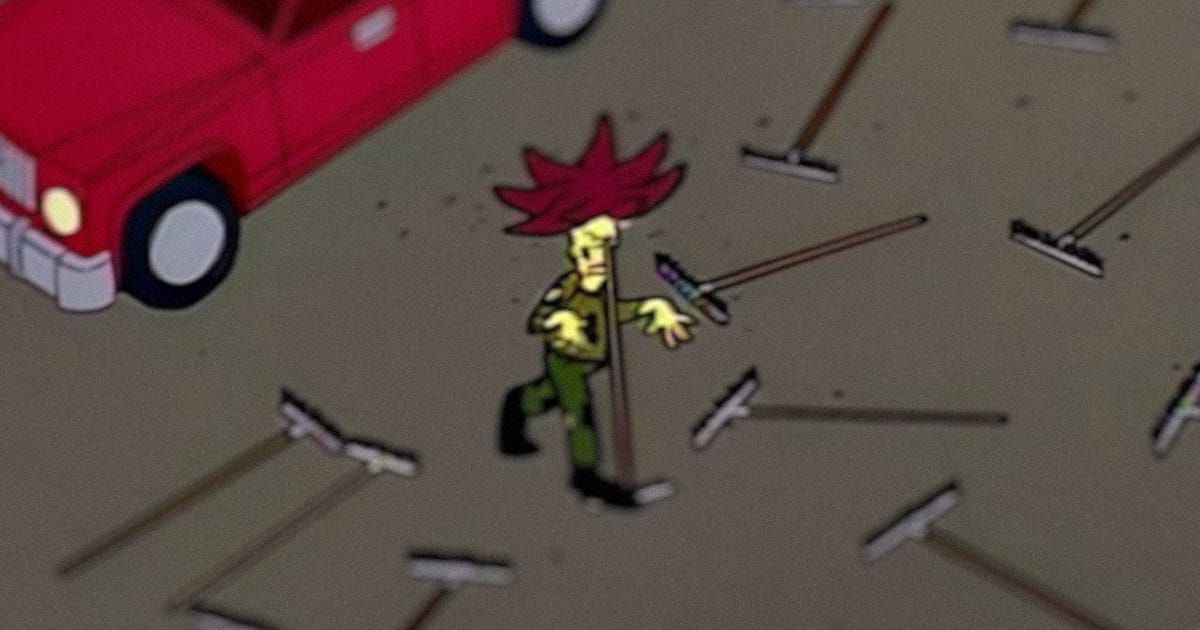
The Simpsons can surely take credit for keeping the stepping-on-rake gag in the popular consciousness. In the 1993 episode "Cape Feare," Sideshow Bob steps on a series of rakes for a full 30 seconds. The joke has been called "iconic" and "one of the best jokes in Simpsons history." Bob's rake stepping is famous enough to be its own source of trivia (it was devised to pad the episode's runtime) and occupies a permanent space in the brains of comedy nerds, particularly the millennials who grew up with it. Sideshow Bob's voice actor Kelsey Grammer was still fielding questions about the joke over three decades later in a 2025 interview with Jesse Thorn.
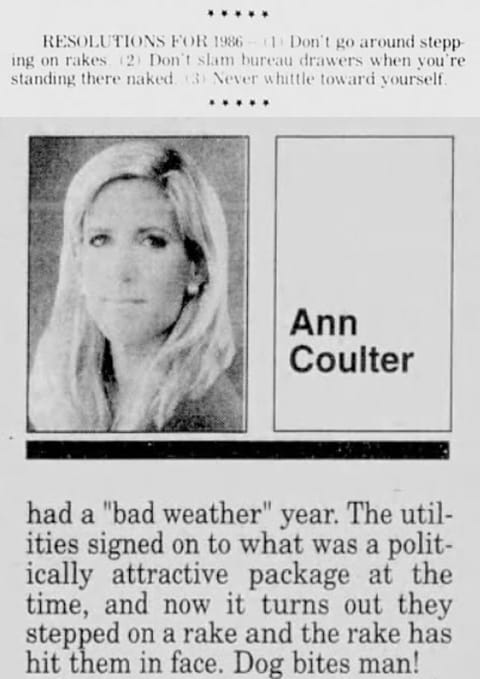
If "stepping on rakes" is a metaphor for an avoidable accident, then the Sideshow Bob gag is the perfectly meme-able rendition of that metaphor, dialed to eleven and making it clear how embarrassing it is to not notice a large farm tool on the ground in front of you (or, in Bob's case, many farm tools). To step on a rake is to commit a foreseeable and therefore risible error. You'll survive, and you really should have known better. A humorist in 1985 included stepping on rakes among other eminently preventable accidents. The now marginal but once influential conservative commentator Ann Coulter gave us another illustrative mention in 2001: in describing the dysfunctional liberal government of California, she mentions rake-stepping alongside "Dog bites man," both phrases describing something banally predictable.
But what if you can't have known better, and what if you won't survive? And I mean that literally—what if you might actually die? These accidents were always funny (getting bonked on the head is funny), and so to step on a rake has always been a joke. However, what is today a symbol of predictable consequences was once the total opposite: an unforeseen, even inevitable disaster.
Eject the cartoon imagery from your mind. Imagine yourself in the 19th century and think through the real-world scenario of stepping onto a rake. This is not the plastic-pronged equipment of the suburbs—this is a heavy duty farm tool. The rake head might be made of sharp steel teeth, essentially a row of knives, with a handle of solid wood. You are working in the early morning or in pre-electrical barns and warehouses, so visibility is spotty at best. Maybe you are not a wage laborer at all but a barefoot family member down on the farm.
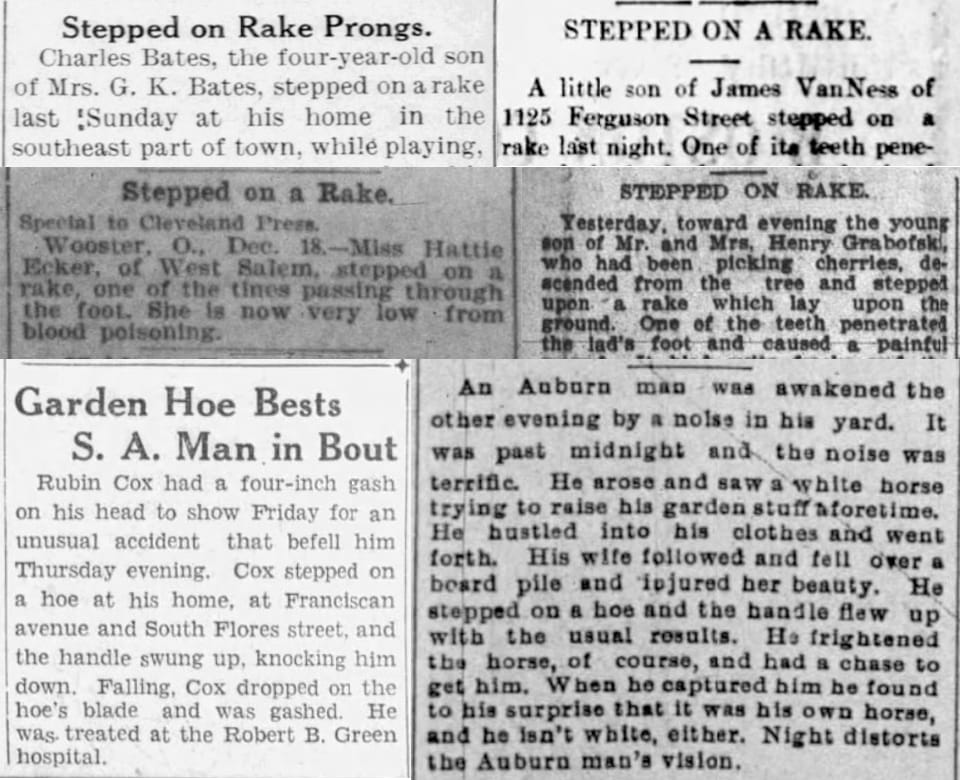
Stepping on a rake, far from a survivable embarrassment, sucked ass. The rake popping up and smacking your head was the best case scenario: often, the rake teeth would spear the victim's foot. People and animals (usually horses) suffered terrible injuries all the time. These injuries predated modern medicine, and so people could become disabled, amputated, or die from infection. Indeed, these injuries were of interest to the developing medical profession. An 1886 issue of The Journal of the American Medical Association presents the case of a woman who stepped on a rake and developed a "venous blood tumor" where the rake handle struck her.
It is hard to overemphasize the frequency of such accidents. Rake injuries (and hoe injuries, for similar reasons) were a recurring local news item, and I personally found dozens of reports before deciding I'd read enough descriptions of gruesome flesh wounds. I will spare the reader the most upsetting tales, but know that these are some of the more fortunate souls:
If getting hit in the head was the best case scenario, it still sucked, albeit to a lesser degree of ass. Being whapped in the head by a heavy piece of wood can cause all sorts of problems, from blunt trauma to cranial bleeding to risk of blindness. An 1892 story from Pennsylvania was given the rather direct headline "How It Must Have Hurt" and described one John Shrawder stepping on a rake and receiving a "dangerous blow on his eye, almost destroying his sight." Violent rake encounters were thus shocking, sometimes bloody affairs.
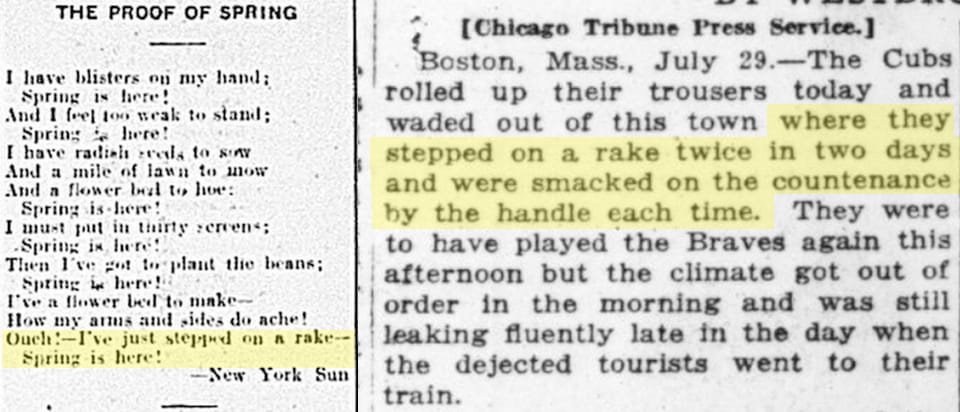
Shocking and, yes, completely normal. A humorous 1924 poem titled "The Proof of Spring" describes a rake-stepping accident as part of the season, as natural as growing grass. A 1926 report on the Chicago Cubs (a mere 18 years into their 108-year World Series drought) illustrates that the rake-stepping metaphor was, at that point, comparable to an act of god. A sports reporter described two unforeseeable rain-outs as "[stepping] on a rake twice in two days." To step on a rake was no more your fault than the weather.
There was another important difference between early rake jokes and latter-day japes: the direction of attack. The front-of-face rake strike we know today emphasizes the foolishness of the scenario—the thing is non-metaphorically under your nose, and the rake-stepper gets instant visual confirmation of their stupidity. A blow from behind, however, is shocking and surprising, indistinguishable from a scoundrel sneaking up and striking you with a blackjack.
Early rake jokes focused on just that: a hapless subject believing they had gotten into a fight. An 1869 newspaper reported on a speech that included a humorous anecdote that ostensibly occurred in 1775 involving a Dutch fieldworker spotting patrolling redcoats.
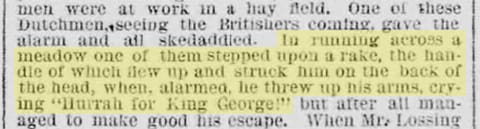
Many examples of such jokes survive in the print record and so must have been common in people's comedy repertoires at the time. The subject of the joke was usually a coward or fool, who either revealed their cowardice after being struck or believed they had entered a melee but never could figure out who they had fought. Some of these stories are presented as real reports, and though some are likely fictional or embellished, we must remember this was a time before electric lights. It's quite plausible that someone would be confused after being stunned in a pitch-black barn. (The story about “John” in the introductory quote above is about a child failing to do his chores during the day and so must enter a “dark woodshed” in “deep twilight.”)
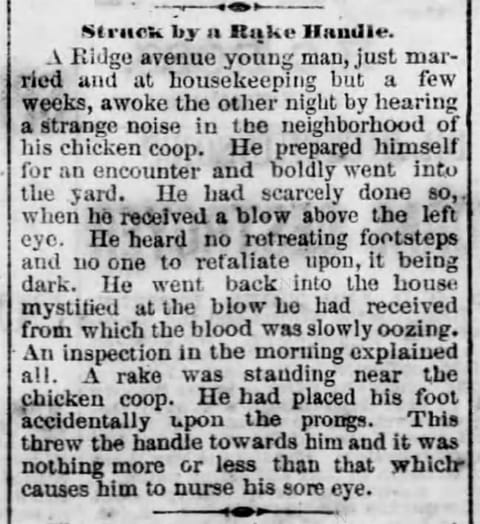
This same basic joke would extend into the 20th century. Henny Youngman brought nut-smashing innovation to the premise with the joke, "While playing golf today, I hit two good balls. I stepped on a rake." These are all variations on a theme, though. A cop joke hearkens back to the earliest rake jokes and was reprinted over multiple decades. This clipping is from 1952 and still found its way into newspaper humor sections in 1979. A quick search confirms this joke still circulates on Facebook today.
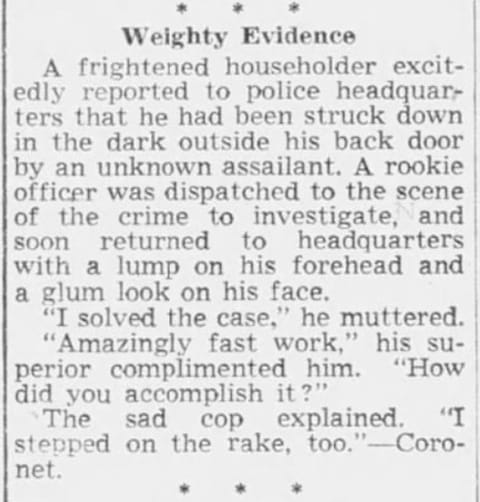
Something started to shift, though. The further you go into the 20th century, the more rake injuries start to feel fraudulent. As early as the 1920s, "I stepped on a rake" was becoming a preposterous explanation for an injury, despite such injuries being real and common-place years prior. More darkly, "She stepped on a rake" begins to appear as a flimsy disguise for domestic violence, a cover-up in the vein of "She fell down the stairs." A 1975 poem shows that, by that decade, stepping on a rake had become firmly entrenched as something unbelievable. That it might actually happen for real is now a comedic premise rather than an everyday hazard.
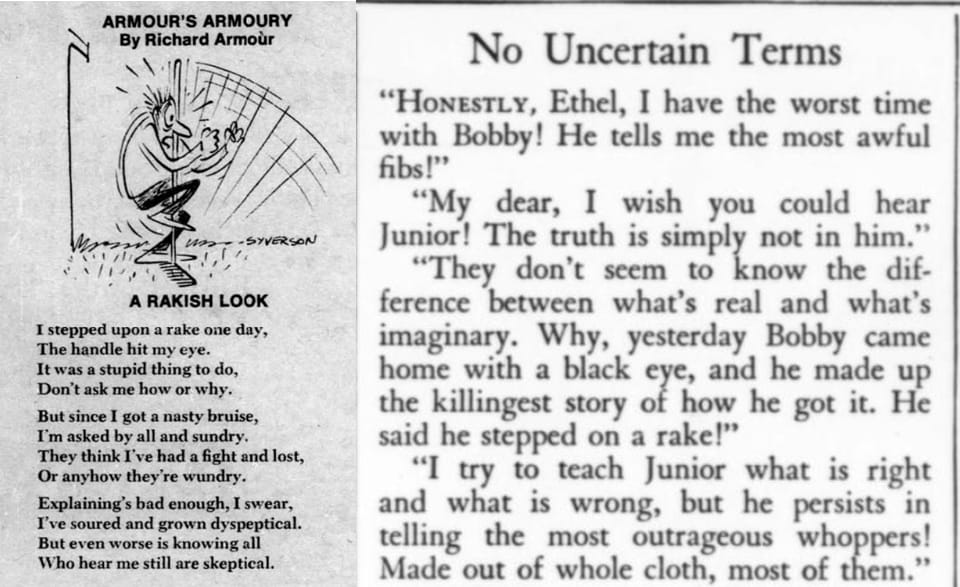
Before long the joke would become the one we know today: the act of god has become the foolish mistake. The unavoidable problem is now a trap only dummies fall into. Jokes change over time: cultural contexts shift, we work different jobs now than we did 150 years ago, most days pass without needing to worry about getting run down by British militiamen. (Though, as I write this, that risk is greater than zero.) But less often does a joke reverse meaning entirely, especially in such a short time span. So what exactly happened with stepping on rakes?
The Punchline
"An ounce of Be Careful beats a pound of I'm Sorry." So reads the epigraph for Catherine Bryce's 1938 children's book The Safe-Way Club. But that is not the pledge of the titular club. The cherubic American youths of the club, with names like Billy and Betty and Mary and Ned, gather after school to tell stories about people suffering from preventable mishaps. In the book, the members hold meetings and recite the club pledge: "I promise to do all I can to stop accidents from happening." In one story, a member named Peter discards an orange peel on the sidewalk where the family gardener slips on and hurts his back.
In another story, young Charles arrives late to a meeting of the Safe-Way Club because, as you might be suspecting, he stepped on a rake that wasn't put away properly.
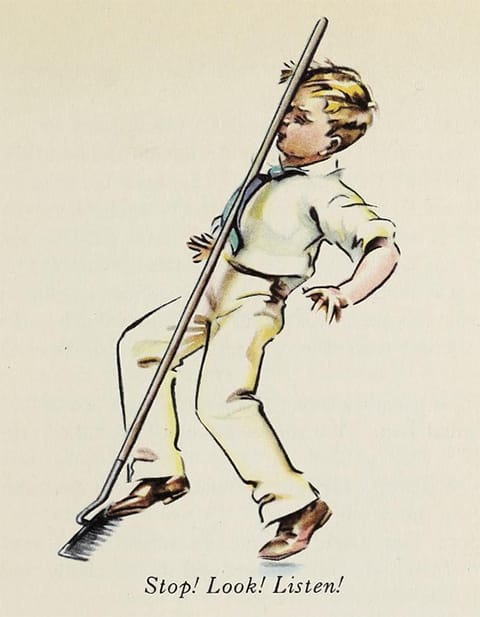
“Been in a fight?” the club asks Charles, a perhaps knowing wink at old jokes. Charles reveals it was left in the grass by “a careless boy” who turns out, he admits, to be himself. The club members agree it was a “silly thing” to do and pledge to put rakes away where they belong.
Charles is hurt and embarrassed (especially as a member of the Safe-Way Club, where this is a major fuck-up). But most injured is his dignity. He does not lacerate his foot or need to be rushed to a doctor. What was once injury is now incident, softened to the point where it is no longer tragic news but a moral tale in a children’s book.
One might assume that the rate of rake accidents fell because of macro societal trends, of people moving out of agricultural work, of medicine improving, of improvements in technology and equipment. Those are all surely factors. More directly for the rake-stepping joke, the world was getting safer, and rakes specifically were a subject of safety campaigns.
From 1924, The Boys and Girls of Wake-Up Town is another children’s safety manual that features a more serious dramatization. A character named Mary Careless steps on a rake and stabs her foot through the iron spikes. Unlike Charles 14 years later, Mary is taken to the hospital and misses two weeks of school.
In 1928, an advertisement for then-newfangled batteries, to be used in then-newfangled flashlights, featured rake accidents prominently. The headline blares “The night I stepped on a rake…” and ran in The Progressive Farmer. The makers of Eveready Batteries, at least, thought that farmers would be lured in by a solution to a common danger.
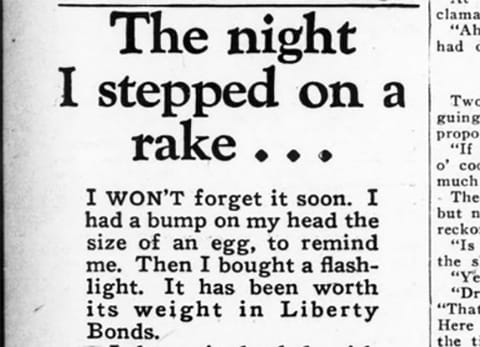
Amateurs were also bombarded with advice. Newspapers printed and reprinted safety tips for home gardeners. "Many accidents are caused in the yard, such as stepping on rakes," said one 1962 writer before emphasizing they “could be prevented.” A 1965 piece warned readers, "Stepping on a hoe can cause the handle to fly up [and] plant a goose-egg size bump." That piece was reprinted in different newspapers over the next decade.
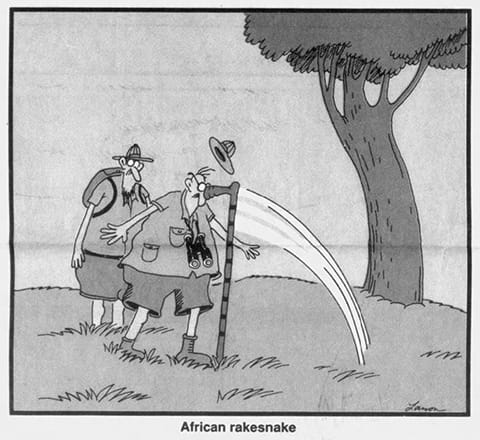
Even into the 90s, writers warned aspiring green thumbs about an accident that was, by then, a legendary and increasingly meta joke. A 1990 article about gardening hazards described a woman who stepped on a rake and smashed her collarbone. "Many such accidents,” says the piece, “are preventable with proper garden safety practices.” This was just three years before The Simpsons would push the joke into absurdity, and the writers of The Simpsons were far from the only comedians experimenting with the venerable gag.
A word must also be said about labor law generally and OSHA specifically. One might assume workplace regulations are also part of this story, and certainly farms are more heavily regulated today than a century ago. Farms, however, have enjoyed a special exception to regulatory pressure. Agriculture companies have always been powerful lobbying forces in American history, and they benefit from the American mythology of farmers: honest, hardworking, and wise. Farms were almost completely omitted from the original 1970 act that established OSHA. Until 1976, OSHA included only four regulations pertaining to farms and, according to one reporter, “none that caused great impact.”
When legislators set their sights on agricultural operations later in the 70s, farm owners rioted. They flooded the media with editorials about government overreach, burdensome and ridiculous rule-making, and out-of-touch Washington lawmakers daring to challenge the heartland sagacity of America’s farmers. (As I write, organizer Dolores Huerta has recently died. The union she helped found, United Farm Workers, was a major player as well.)
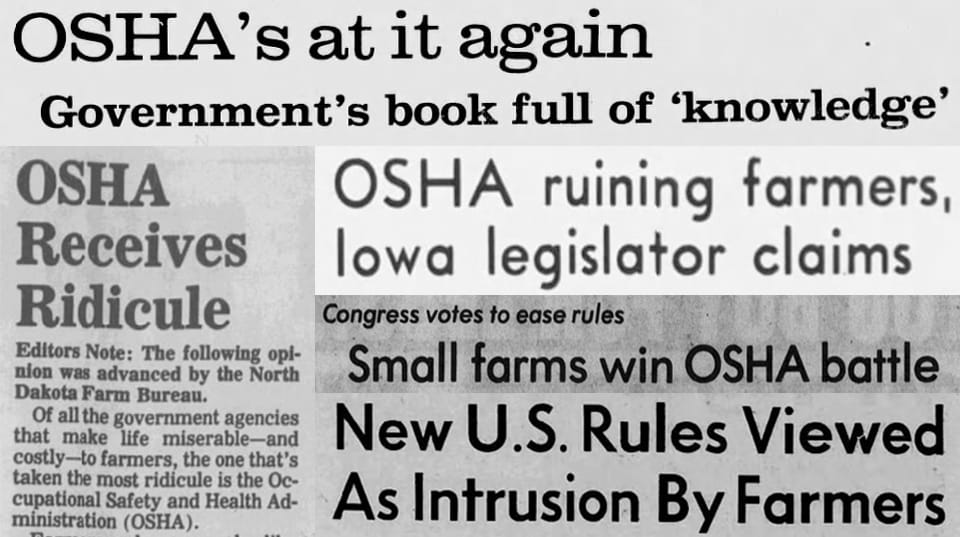
OSHA would go into virtual hibernation during the Reagan years, and to this day farms receive exceptional treatment (small “family farms” are still exempt from OSHA), to say nothing of toothless regulators and straightforward corruption. The improvements to workplace safety is no doubt part of the stepping-on-rakes story, but those improvements were not felt equally in all parts of life or for all people. Stepping on a rake becoming a joke about survivable mishaps is an argument against these pro-business ideologies: under the timeless wisdom of farm owners, workers routinely suffered debilitating injuries, and it was only foolish and burdensome regulations that turned this accident into a sight gag akin to a falling anvil.
This, I think, brings us to the modern day. The image of a dope stepping on a rake has at this point persisted across centuries, and we have always joked about it. But the violence–sometimes gruesomeness–of this scenario has slowly evaporated. And it has evaporated under surprisingly targeted campaigns, of people working to improve their homes and workplaces, yes, and also the safety of rakes in particular.
Now all that is left is an absurdity, an image that no longer parses as realistic and so can only be understood as comedy. How could one possibly do something so stupid as stepping on a rake right in front of them in broad daylight? That’s cartoon shit, something that happens to Sideshow Bob. But it happens to Sideshow Bob and not you because of people who saw a recurring danger in the world and strived to eliminate it. That most of us no longer have to worry about this accident, that it belongs to the world of slapstick and metaphor, is no accident at all.
Postscript
If you enjoyed this post, please consider subscribing to this blog or adding it to your RSS feed.
Below is a list of works quoted and other background reading not otherwise cited above.
- Dvorak, John A. “Crop of OSHA Rules Dismays Farmers.” The Kansas City Times, 9/21/1977.
- Fitzgerald, Tom. “Top of the Sixth.” San Francisco Chronicle, 2/26/1998.
- Gunning, Cathal. “One of The Best Jokes In The Simpsons History Was Secretly Improvised.” ScreenRant.
- “How It Must Have Hurt.” Daily Village Record, 12/13/1892.
- Jordan, Bob. “McReynold’s blast powers Mets.” Asbury Park Press, 6/26/1991.
- McCann-Powell, Andrea. “Hazards may be lurking just around the corner.” The Vincennes Sun-Commercial, 2/25/1990.
- McNab, JM. “‘The Simpsons’ Classic Rake Gag Was Created to Fill Extra Time.” Cracked.com.
- Thorn, Jesse. Interview with Kelsey Grammer. Bullseye with Jesse Thorn, 2/18/2025.
- Mastin, WMM. “Venous Blood Tumors of the Cranium.” The Journal of the American Medical Association, 9/25/1886.
- Sharpe, Harvey. “Careless Handling of Pesticides and Tools Can Make Gardening a Hazardous Occupation.” The Stuart News, 11/4/1965.
- “‘Yard’ Safety Subject for 4-H Article.” The Ironton Tribute, 7/20/1962.