Sleeping with the Milkman

The Setup
“Having been incarcerated in her vile womb for nine months, I can say with certainty that the wretched nasally voiced redhead is my mother, but one glance at the fat man tells you I'm hardly a chip off the old moron. So, let's just say I wouldn't be surprised if you were to tell me the milkman has an enormous, football-shaped head.”
–Stewie Griffin (Steve Callaghan), Family Guy: Stewie's Guide to World Domination, 2005, back when Stewie still wanted to kill Lois? Does he do that anymore? I haven’t watched Family Guy in 25 years
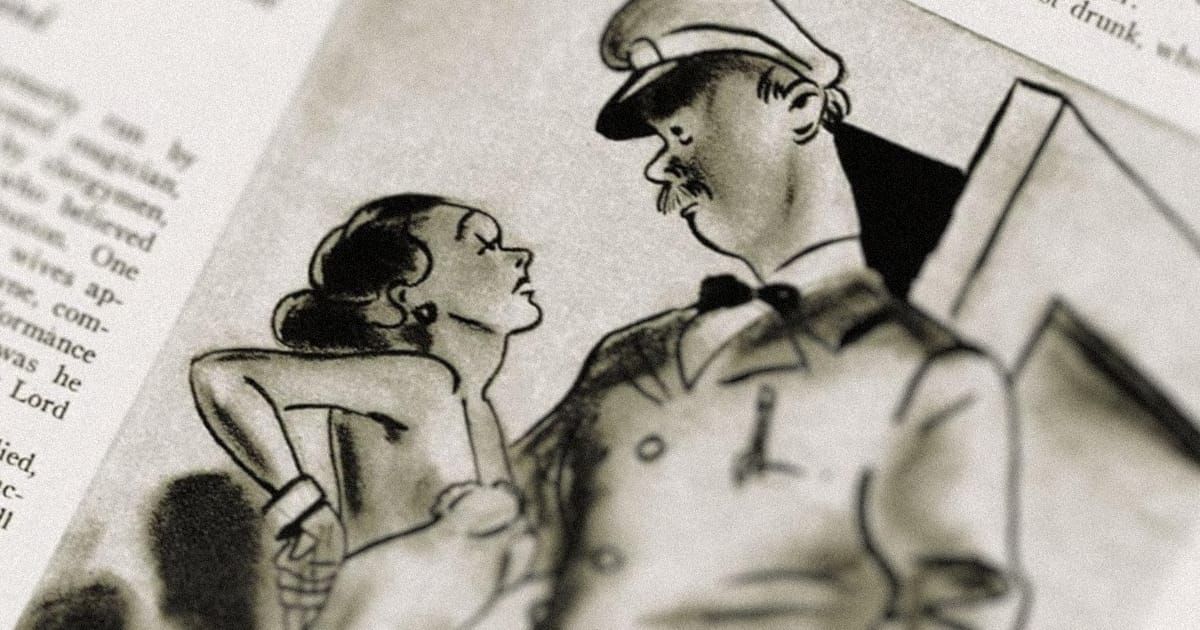
He was once inescapable–almost literally so, as he arrived at your house every single morning. His jokes range from cheeky to obscene, from winking innuendo to racialized cuckoldry. The milkman was a sexual prowler and still is to people familiar with a premise that is long obsolete in the modern world. When he appears in a joke, we brace for a punchline about carnal shenanigans or marital infidelity or children of dubious provenance. Sometimes he initiates the hookup. More often, the milkman is seduced by a housewife unsatisfied with her own husband.
We might find it odd, then, that this legendary philanderer is barely a character at all. In his own jokes, he is often anonymous, a useful stock character, given a proper name only if the punchline demands it. His jokes are not “his” jokes at all. They are instead about the people he sleeps with. The milkman’s story is that of the women he visits.
The milkman is such a cartoon character now that we must remember how ubiquitous he once was. Before suburbanization and modern food preservation, milk could not travel or store well. Absent a cow of one’s own (my favorite Virginia Woolf book), families had to pay a milkman to deliver it from a local dairy. Milk arrived daily to be used daily–it would spoil otherwise. The US government did not perform a survey of milk deliveries until the 1960s, but in 1963 roughly 30% of consumers received milk deliveries, and this was during a rapid decline from the milkman’s peak; by 1975, that number fell to 7%. If a third of Americans still paid a milkman in the early 1960s, we can extrapolate how much larger that percentage would be in years prior.
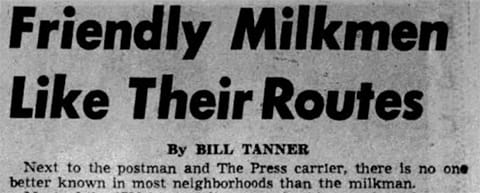
So imagine how well you would know your milkman in the 1800s and early 1900s, how prominent a role he would play in your life. He was much more than an anonymous professional–he was a fellow you’d see hundreds of times a year. Milkmen would be friends and neighbors, people whose names you knew. Because they perform de facto check-ins on households, milkmen frequently pop up in news reports too. (I lost count of how many stories I read about a milkman discovering a dead body.)
Naturally, the milkman appeared in jokes as well, and in many jokes beyond bawdy sexual encounters. The comedy magazine Judge, which ran from 1881 to 1947, mentions milkmen hundreds of times. He sometimes played the role of a cheat or charlatan, someone who would adulterate his product to increase his profits. (To “chalk” milk was to water it down and maintain the color and consistency with chalk.) His day started so early, well before sunrise, that he was also a late-night taxi: to “come home with the milkman” was not a sexual euphemism but a phrase that meant to come home at the same time the milkman delivered his wares, sometimes literally hitching a ride on his wagon. In jokes involving a husband who stayed out too late, the milkman was often the one depositing his inebriated body.
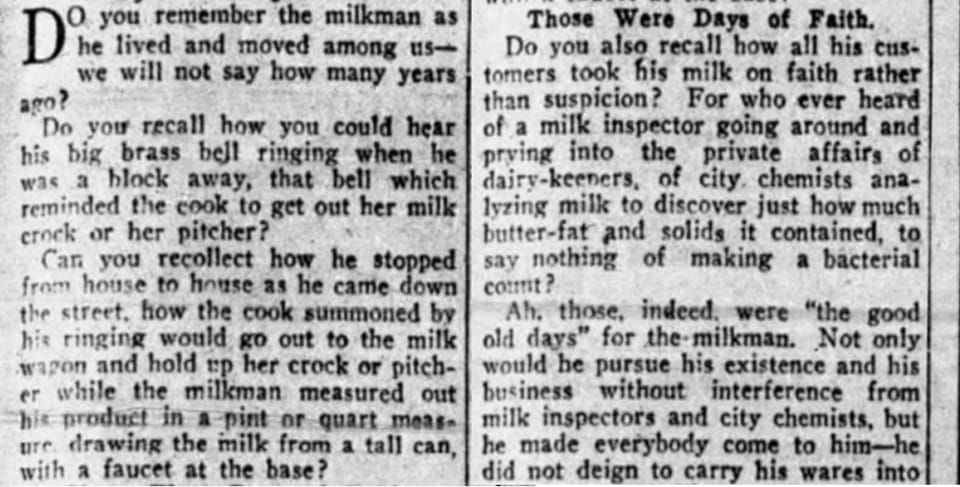
Sexual dalliances, in fact, would have made little sense before the suburbanization of the 20th century. The “stay-at-home wife,” a woman living a life of idle convenience, was a later invention. The milkman’s arrival at a rural farm indicated the start of the workday, not an early morning quickie. The wife had to be up at the crack of dawn to accept the milk and begin all the chores that defined rural existence: cooking, cleaning, farming, tending to children, and all the other “woman’s work” that was in truth an awful lot of work. It’s likely the husband was nearby too, not miles away at an office. A 1919 newspaper article–already nostalgic for “the good old days” of the milkman’s existence–wistfully recalls the scene:
If a wife could not invite the milkman inside, he nonetheless was a sexual figure. For many women, the milkman was one of the few men they saw besides their husband. He was a lifeline to the outside world and represented both a threat to other men and a temptation for isolated women. However tightly a man might secure his home, however removed from society his family might be, the milkman was the arm with which society kept rapping at his door.
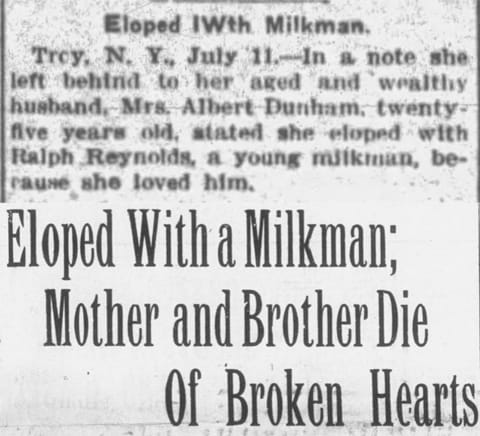
The first forms of the “sexual milkman” jokes were not that the milkman visited the woman but that the woman fled with him. “Running away with the milkman” was a common phrase and more than a joke, occurring with some regularity in real life. Milkmen, again, were regular visitors, and the occasional romance blossomed alongside relationships of less sentimental motivation. These two clips show two very different couplings, an elopement of simple love and another of a man and woman abandoning–and apparently devastating–their existing families. I found several other stories of milkmen absconding with teenage girls young enough that the police became involved.
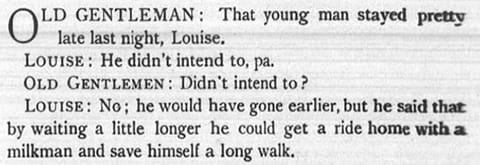
The jokes were as numerous as these real-world incidents and appeared in a wide variety of media. Let’s look at a few: a newspaper comic, a prose introduction in a Canadian cookbook, and a children’s riddle. (The cookbook excerpt is proof that recipe writers have always included interminable personal diaries.) I find the 1919 riddle particularly remarkable because it is included in a newspaper’s “Childrens Page,” not even really a joke, just an amusing scenario. It was a common enough setup, and hardly lurid, that nobody thought twice about kids reading it.
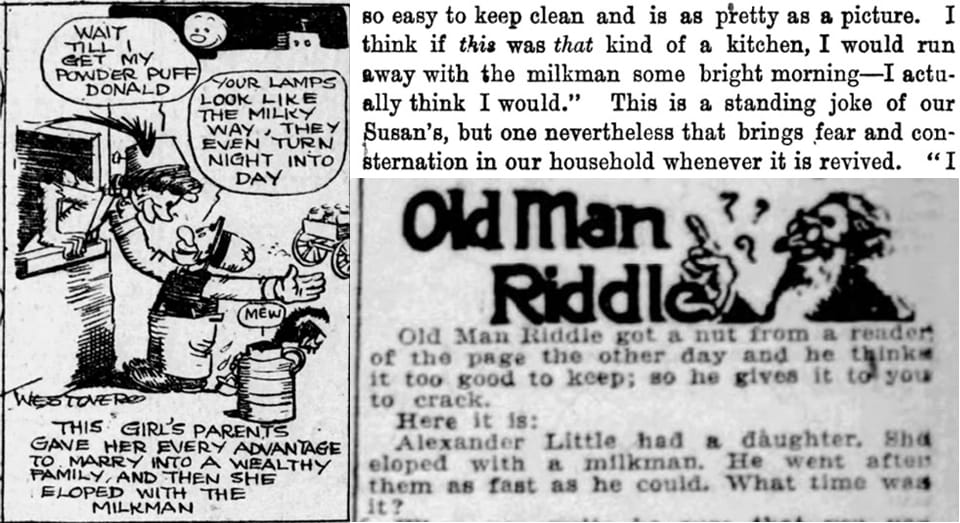
As you encounter more and more of these jokes, a theme clearly emerges: these are not dirty or sexy jokes (as they would eventually become). These jokes are about women asserting their autonomy. The comic above is about a young woman who is liberated to the point of foolishness and ungrateful for her family’s support. The cookbook excerpt highlights that women used “the milkman” as less a real person and more a metaphor for their own ability to walk away from a relationship–and as that excerpt states, there were strong emotions behind the sentiment, real concern lurking underneath domestic banter.
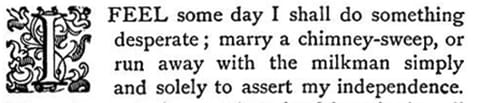
That banter occurred within the eruption of women’s rights movements in the late 19th and early 20th century, what would become known as first-wave feminism. (Readers will note the foreshadowing of a subsequent, higher-numbered wave.) Activists were agitating across much of the globe, and so to make a joke about running away with the milkman would have tapped into those loud public debates. These jokes are not about who a woman marries or sleeps with but that she would dare to make that decision herself. The British authors Evelyn Everett-Green and Hannah Louisa Bedford, in their 1895 romance His Choice–and Hers, makes the point comically obvious: when a young woman threatens to run away with the milkman she is talking about not his life but hers, “simply and solely”:
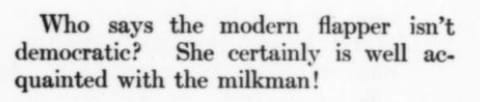
We will eventually find ourselves in crasser territory, with jokes more familiar to a modern audience. As women’s rights marched forward, milkmen jokes followed suit. If we fast forward to the 1920s, where before farmers’ daughters fled their homestead, now the city-dwelling “modern flapper” is made fun of for her sexual promiscuity. A joke in a 1924 issue of Judge derides the “democratic” flapper as someone who sleeps around too much, exploiting the familiar framing that women cannot be allowed too many rights or else they’ll become perilously slutty.
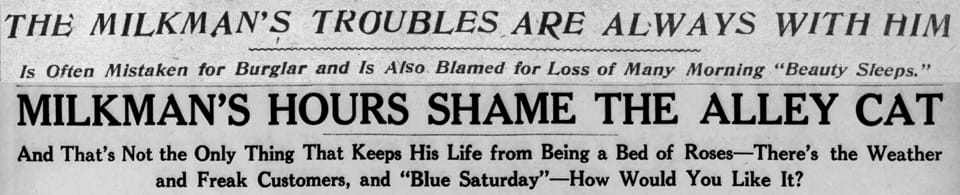
We must briefly also check in with the milkman. He is a working man and so has always wrestled with the usual struggles of labor, of wages and working conditions. Numerous newspaper stories through the years have reported on the difficulty of the job. As mentioned above, he was not always well regarded by his customers. He could be accused of being a cheat. He could be late or miss deliveries, or a thief might steal the milk off a stoop leaving the milkman to take the blame. The milkman might be mistaken for a thief himself prowling about in the darkness. (Stories survive of paranoid customers firing guns at an imagined burglar.) Perhaps most notoriously, the milkman could make an obnoxious racket, waking people up with the jangling and clinking of a vehicle full of glass bottles.
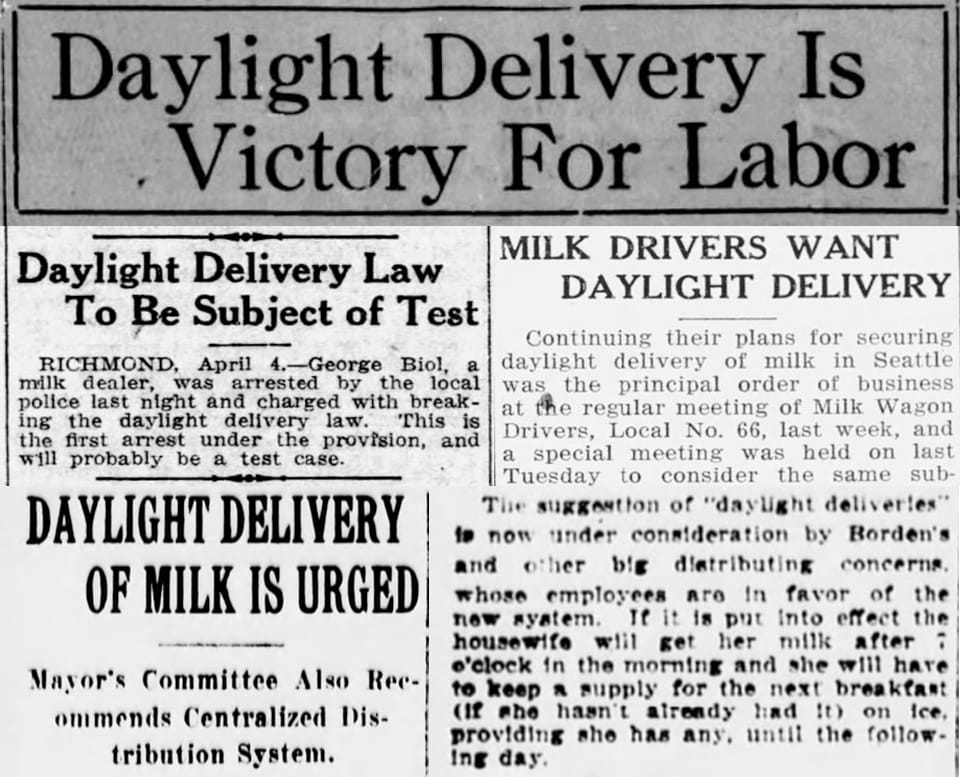
As families left the countryside, as the early-morn lifestyle of a farming household became rarer, it made less and less sense for milkmen to make deliveries before the sun came up. Customers hated being disturbed, and milkmen started to resent the hassle (and sometimes danger) of their traditional schedule. “Daylight delivery” was a serious labor issue in the 1910s and some municipalities made it illegal to deliver milk at night. Though this was specifically a labor issue concerning milkmen, the housewife remains too closely entangled with the milkman to escape mention. One New York newspaper couldn't help but note that if the law is put into effect “the housewife will get her milk after 7 o’clock in the morning and she will have to keep a supply for the next breakfast on ice.”
The mention of an icebox tips us that the country is changing. We are entering the modern, comfortable life of the American suburbs, with preserved food and electric appliances and none of that crack-of-dawn farmer bullshit. Before long, we find ourselves in the milkman joke’s natural environment: a loveless suburban household. The woman in these jokes is now definitively a wife, someone who is not looking to escape but to fill the void of a long day at home. And the man is now definitively a husband, not a protective father or the rugged head of a rural household. He is a soft, modern man, unaware of the cuckoldry occurring under his roof. “Oblivious husband betrayed by sexually unfulfilled wife” has been the joke’s crystallized format for almost a century now, from a newspaper gag in 1948 to an Onion joke posted in 2026.
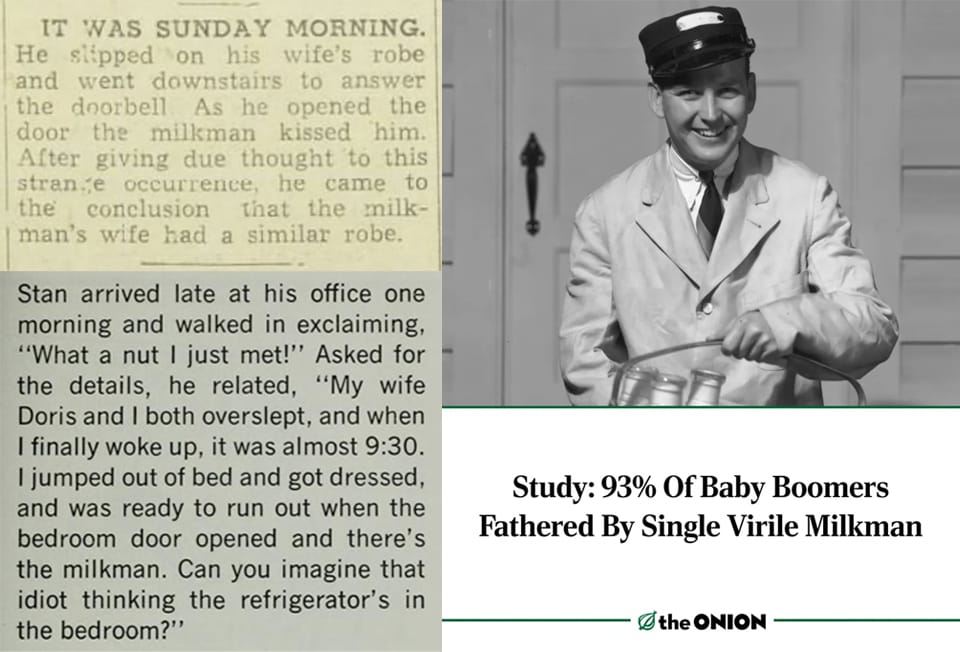
You can, of course, find many more examples. Another major genre is the milkman of a different skin color, producing children which make the husband’s cucked-ness comically obvious. Though other blue-collar laborers sometimes fill the role of the sexual interloper (like the notorious porno plumber), the milkman easily takes the crown as “Most Common Guy In Sex Jokes.” Round of applause for him!
The question, then, is how often did this really happen? If rural women sometimes did run away with the milkman, did suburban housewives actually sleep with him?
The Punchline
There is much more to say about the suburban milieu in which we find the milkman. He did not simply happen upon a home fraught with marital strife. Milkman jokes changed to meet the moment, to reflect the anxieties of a movement that would come to be known as (crash of thunder, dramatic musical sting) second-wave feminism.
One of the core texts of second-wave feminism, and the name someone knows if they know only one piece of feminist literature, is Betty Friedan’s The Feminine Mystique. Published in 1963, Friedan described “the problem that has no name,” an indefinable-but-pervasive unhappiness roiling American women in the 1950s and 1960s.
This unhappiness most severely afflicted educated stay-at-home wives. After a surge of women entered the workforce in prior decades, especially during World War 2, those trends reversed: women worked less, had children earlier, and faced empty-nest ennui at young ages. Well appointed suburban homes required less upkeep, and suburban sprawl neutered opportunities for social interaction. Women who read poetry and wrote papers and debated their peers in college, and who might have pursued a career a decade prior, found themselves merely existing in isolated cul-de-sacs. Friedan waxed nostalgic for the freethinking suffragists and flappers of previous generations and bemoaned the infantilized, objectified existence of the modern woman. (The character Betty Draper in Mad Men is practically an anthropomorphized version of this book.)
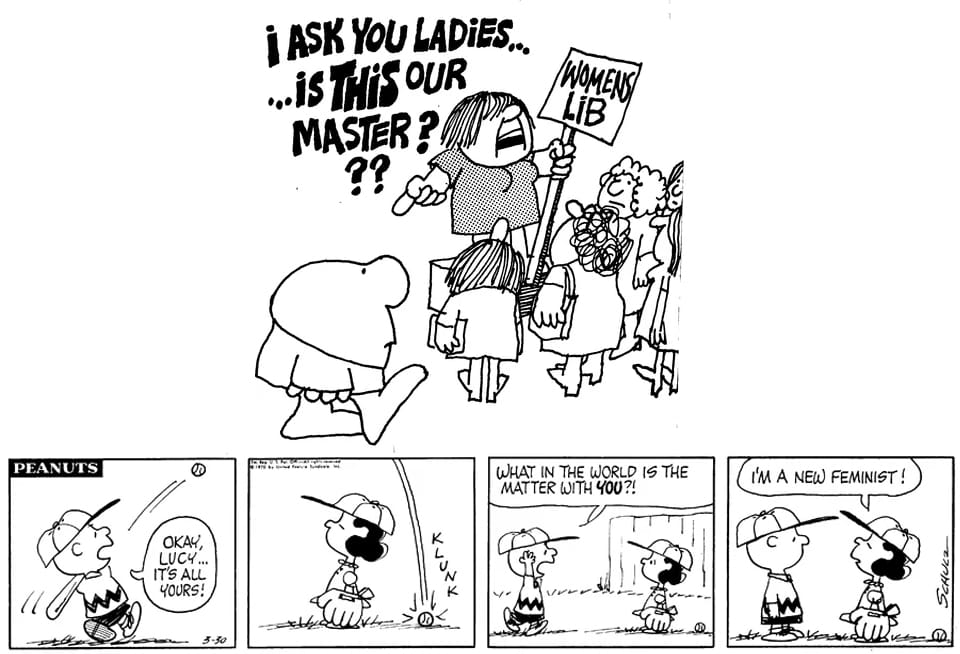
Friedan, and second-wave feminism generally, has always faced criticism for focusing on well-to-do white women (and a subset of them at that). But the trends she discussed were nonetheless real, and the milkman persisted as an avatar for despondent suburban women. The writer Phyllis Lee Levin wrote in an essay in 1960, quoted by Friedan in The Feminine Mystique, “Once she wrote a paper on the Graveyard Poets; now she writes notes to the milkman.” Also in 1960, Herma Snider wrote for Redbook, "Cemented to my house by three young children, there were days in which I saw no adult human being except the milkman." One sociology book from 1962 quotes an older woman saying that women today see fewer people than she did in her youth: “the girls today...never see anyone but the milkman.”
Indeed, the 50th anniversary edition of The Feminine Mystique added a brand new milkman reference. In the introduction by Gail Collins, she writes, “I grew up in one in Cincinnati, where the dads drove off to work every morning in what was then the only family car, leaving behind a land in which the only adult males were Tommy the milkman and Art, who drove an old bus that had been outfitted with shelves of groceries that he sold to the stranded housewives.”
The milkman as metaphor was as prevalent as ever, but in real life his profession was in rapid decline, so who was actually sleeping with this guy? Rolling around with the milkman was certainly discussed as if it could happen. A 1974 book on women's sexuality quotes one woman about her masturbation habits. She describes it as positive but "a substitute...it is better to masturbate than to get so pent-up that you ask the milkman to come in." (She added, "It made it possible to bear my husband who was clumsy and seldom satisfied me.” Come on man!) A 1967 book on women and alcoholism describes, with perhaps too much concern for a woman’s attractiveness to her husband, the dangers of addiction: “your husband will rapidly begin to lose interest in you. If you drink...you will lie to your husband frequently. You may possibly wind up with the milkman, the golf pro, your boss, or your neighbor's husband.”
Eventually, the question began to be asked directly, so common was the joke that it might have seemed real. In 1982, Linda Wolfe published The Cosmo Report, marketed as the largest ever survey of women's sexuality based on over 100,000 responses from readers of Cosmopolitan. Contemporary reviewers noted that the book may be less-than-scientific, narrowly focused on self-selecting Cosmo readers, and perhaps a little sensational. But it is a wide-ranging and (for the era) provocative book, discussing topics like orgasm frequency, number of sexual partners, and, relevant to the milkman, infidelity.
Wolfe in fact begins the section on infidelity by recapping its most famous stereotype: “In short stories and novels about women’s infidelity, it is usually the idle wife who has an affair…The milkman and the mailman and the newspaper delivery boy are the storied beneficiaries of the housewife’s alleged lust.” Wolfe is quick to explain her position, a position of some authority given how many survey responses she saw: “This is myth,” she says, “and most likely male myth.” That a woman would be overcome by sexual mania suggests her sex drive is irrational and unserious and, therefore, unthreatening to the husband.
In practice, people cheat for many reasons. The Cosmo Report details some: loneliness, boredom, sexual dissatisfaction, emotional negligence, or revenge against a partner who cheated first. People cheat with friends and coworkers and old boyfriends, or if they hook up with strangers they do so in more hanky-panky-inclined environments. They rarely cheat with strangers knocking on their door at 9 AM in the middle of a work shift. That certainly would not appeal to me unless I was experiencing a horniness of profound desperation.
And at least one person would agree with me. In 1975, English actress Diana Dors starred in the softcore sex comedy The Amorous Milkman. The film is unwatchable, achieving neither sexiness nor comedy in a way that only the British can fail to do. Dors did, however, reference the film in a book titled Diana Dors’ A-Z of Men. (And she is English, so be sure to pronounce the zed.) She dedicates the letter M in her A-Z to milkmen. "Whether milkmen really are over-sexed...I do not know," she writes. "Certainly my own neither turns me on nor is even on time with the morning order."
Whether any woman has literally had an affair with her milkman, what is more important is his symbolism. Especially now, when the milkman profession is all but extinct, his work reduced to obscure delivery services, the symbolism is virtually all that remains. He is not a man who sleeps with women but a reminder that women cannot be contained within their homes like human terraria. In stories and jokes, the milkman represents the truth that, despite all efforts, women cannot be separated from social and political life.
That is not my conclusion but Helen H. Gardener’s, a suffragist active in the early 20th century. She campaigned for women’s right to vote and also, in a speech delivered in New Orleans in 1913 and later set down in the US congressional record, argued that women participate in politics whether they want to or not, whether they are suffragists agitating in the streets or housekeepers spending all day inside.
Said Gardener: “A clever writer said, in this connection, that women do not have to go out of the home (which was asserted to be her ‘sphere’) in order to get into politics. Politics comes into the home and gets inside of the baby whenever some milkman with a pull and a dirty farm leaves milk at your front door.”
Postscript
If you enjoyed this post, please consider subscribing to this blog or adding it to your RSS feed.
The solution to the riddle is "A Little after two."
Below is a list of works quoted and other background reading not otherwise cited above.
- DeMartino, Manfred. Sex and the Intelligent Woman. 1974.
- Gardener, Helen H. Woman Suffrage–Which Way? 1913-1914. [Note that the quote above may be unique to the version of this speech submitted to Congress.]
- Kent, Patricia. An American Woman and Alcohol. 1967.
- Levin, Phyllis Lee. "Road From Sophocles to Spock Is Often a Bumpy One; Former Co-eds Find Family Routine Is Stifling Them." 1960.
- Tahmincioglu, Eve. "Remember the Milkman? In Some Places, He’s Back." 2019.