Lawrence Welk

The Setup
"I woke up in an ambulance and it wasn't nothing but white people staring at me. I said, ain't this a bitch? I died and wound up in the wrong motherfucking heaven. Now I gotta listen to Lawrence Welk the rest of my day."
—Richard Pryor, Richard Pryor: Live in Concert, 1979
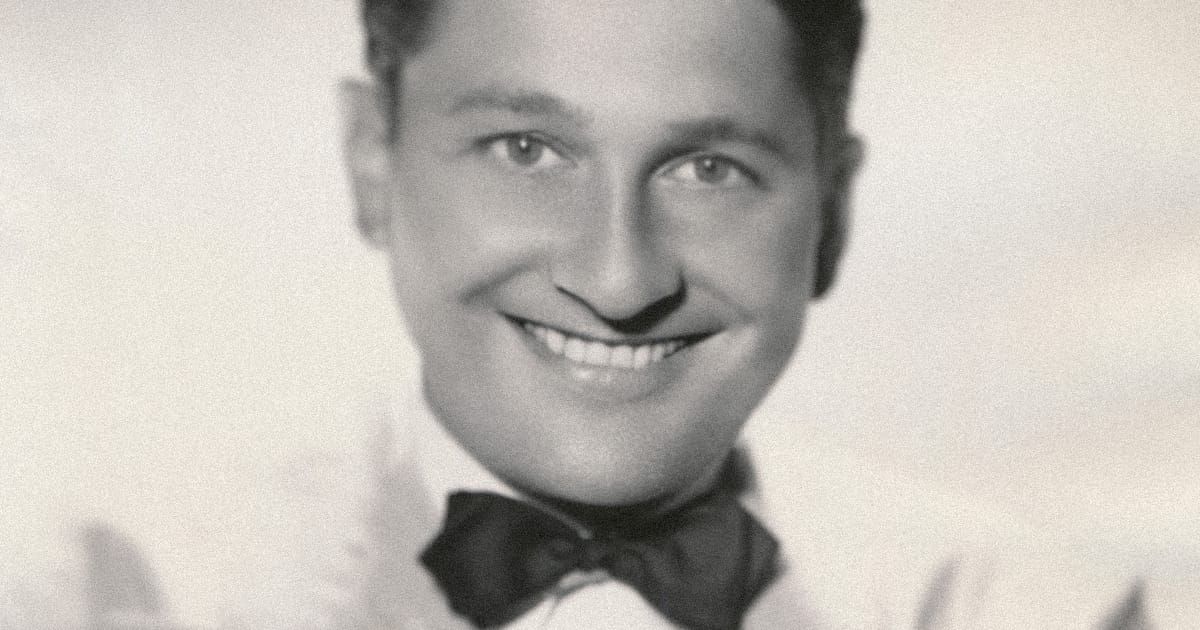
He was known for his “champagne music,” that famously fizzy sound, impossible to describe without using the word "effervescent." Lawrence Welk may not have coined the term–similar phrases predate his debut in the 1930s, and Welk surely wanted to evoke the feel-good tunes of post-Depression cocktail hours. But Welk’s gentle synthesis of jazz and big band was considered “distinctively new” and he embraced his identity as the king of bright, bubbly easy listening. His shows incorporated bubble motifs in music and imagery, and one of his signature moves was to pop his finger in his cheek like a champagne cork. For the better part of the 20th century, Welk was the butt of countless jokes, making fun of his bubbles and his blandness and his distinct "wunnerful, wunnerful" accent. Those bubbles, however, disguised something darker: underneath the fizz simmered a stew of resentment and rage at the social order Lawrence Welk symbolized.
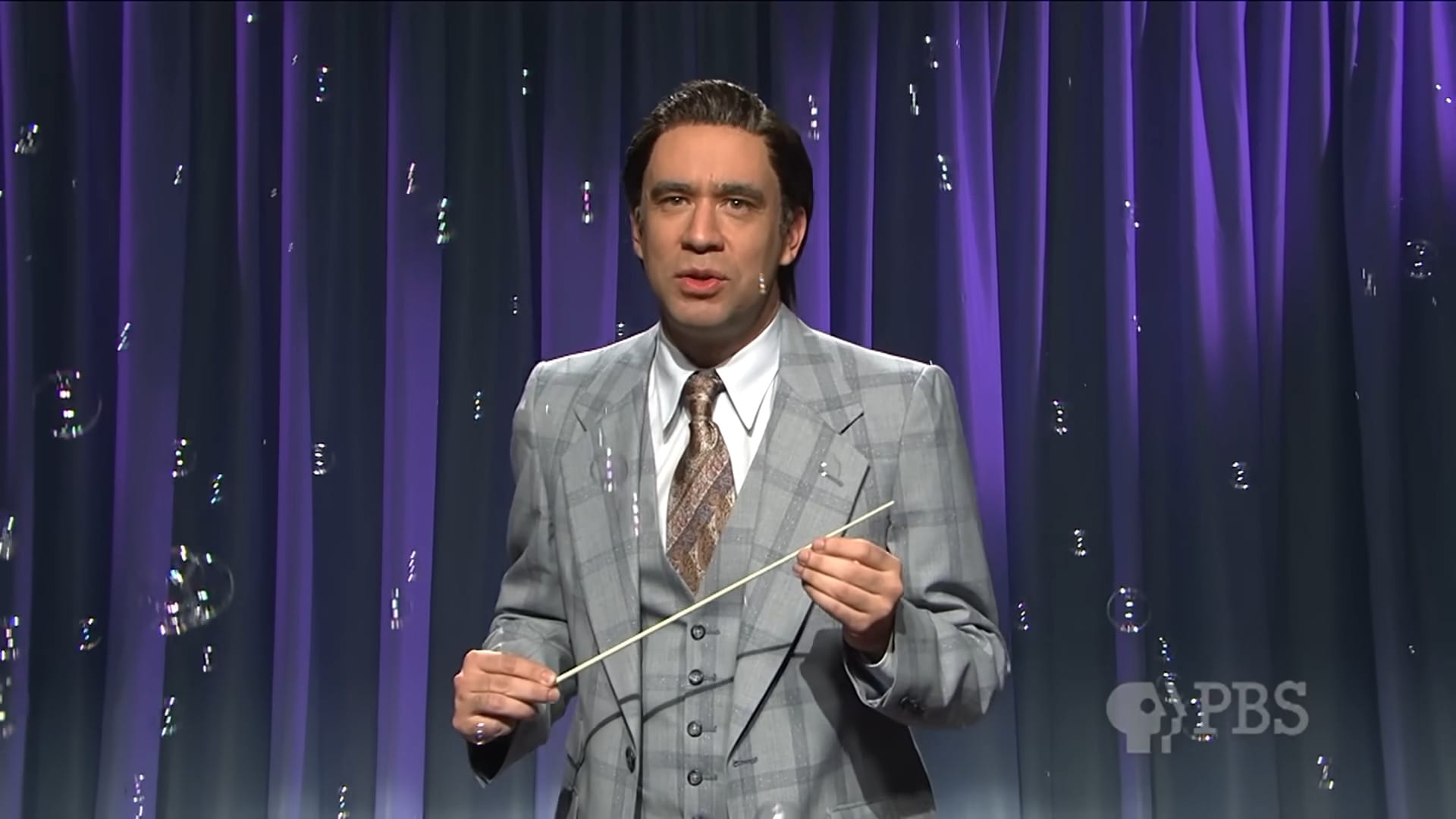
As I write this, Welk still lingers on the edge of popular consciousness though his show ended in 1982 and he died in 1992. Saturday Night Live struck gold with Kristen Wiig’s “Dooneese” character in a series of ten (and counting?) sketches framed as a PBS rerun of The Lawrence Welk Show. Wiig plays one of four sisters in a musical group, the kind of wholesome family act common on Welk’s show. The sketches feature Fred Armisen as Welk, but his role is brief. The specific references to Welk’s persona are surely lost on most viewers under the age of 50. Welk is being invoked not to make fun of a zeitgeist that has long passed but to declare “this is old, and this is boring.”
Welk was, you see, just about the unhippest square there was. He was an avatar for the dullest, most grandparent-friendly media, G-rated entertainment that could barely be said to entertain. The Lawrence Welk Show was a musical variety hour, usually to a theme and often salutingly patriotic–”Summer Sounds,” “Thank You America,” “Tribute to the Armed Forces." Welk or a guest emcee would introduce musical and dancing acts supported by Welk’s band, and audiences would enjoy a never-controversial hour of show tunes and popular standards. Welk himself lived and filmed his show in California when California was an aspirational suburban paradise, and when not in studio the show was sometimes filmed on Welk's sizable estate.
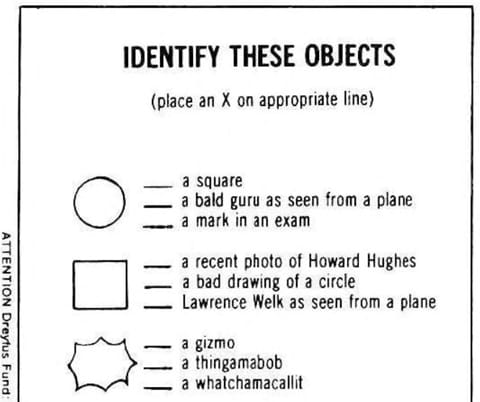
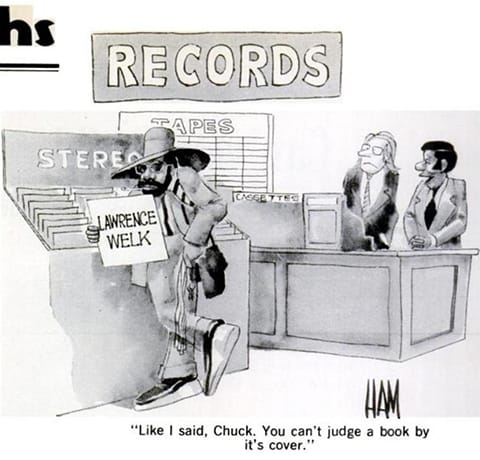
Welk was massively popular and a national figure for many years, his reputation well known, and so the jokes were appropriately blunt. One did not make sly references to Welk: he represented all that was uncool about popular culture and attracted undisguised mockery. This 1971 issue of Sick shows how direct these jokes could be, reducing Welk to the literal shape:
Jokes traded on this tension for years, the tug between Welk's utter lack of coolness and his undeniable popularity. He was an easy punchline because he never went anywhere: he was on TV for decades and survived even longer in reruns. Both before and during his TV run, he was a popular bandleader and charting musician, selling millions of records. Even if one did not know Welk’s reputation, his music evokes a sexless (sex-hostile, really), tedious dinner party that guests leave at the earliest possible opportunity. (Seriously, try to imagine fucking to a song titled “I'm a Ding Dong Daddy from Dumas.”)
Oh, and he played the accordion. We have a word for this kind of guy, an uncool accordionist from North Dakota who sanded every edge off Dixieland jazz until it became swingless mush that brands listeners as out-of-touch dorks and god help you if you try dancing to it. More precisely, more importantly than being a square, Lawrence Welk was white.
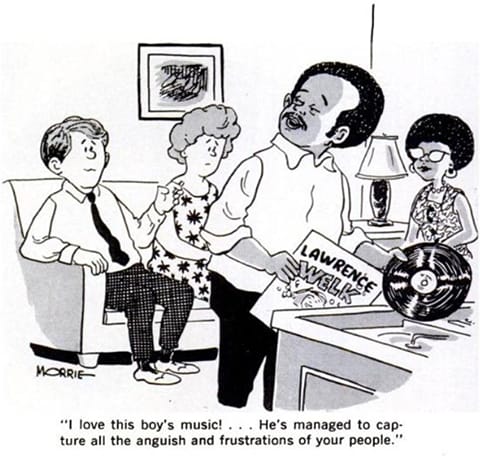
And how! He was a white man and the white man, a synecdochic (look it up) figure representing the untanned whole. Anybody looking to pull a low-hanging reference went for Welk, as in this New York Times review of Bill Cosby's 1960s espionage series I Spy: "When Cosby assumes his role as an undercover agent on television this fall, viewers will get some inkling of how it would be to see Thelonius Monk playing piano in the orchestra of Lawrence Welk." The figures of blackness with which he was compared changed with the years—John Coltrane, Thelonius Monk, James Brown—but Welk persisted as a stalwart of whiteness.
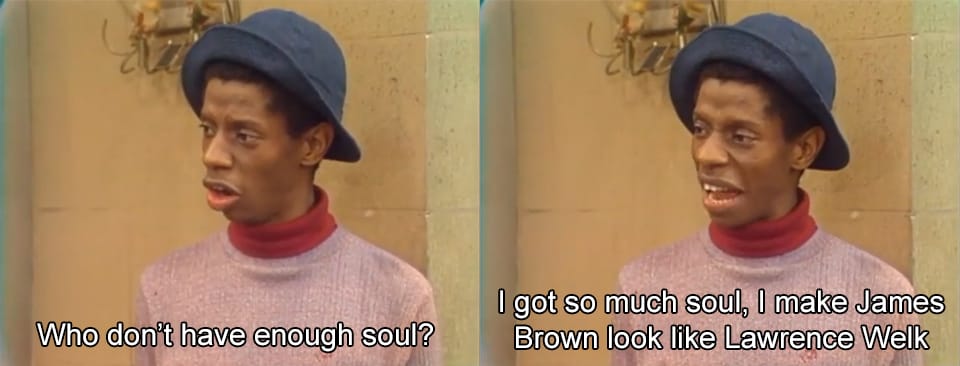
This reputation for extreme whiteness might feel confusing now considering the United States has never lacked for extremely white people. Welk, really, was not white in any extraordinary way. He promoted a typical sort of god-bless-America nationalism but one would hardly call him an extremist or an ideologue. Besides that, to the ears of many listeners, he sucked ass, he was an uncontroversial figure throughout his life. Welk also did not exclude non-white performers: he had a variety of black performers on his show, notably the tap dancer Arthur Duncan, whose status as featured performer was a milestone for black entertainers.
Welk gets few points for activism (one episode of Welk's show features Arthur Duncan dressed as Uncle Remus dancing to the music of Song of the South) but it's hard to characterize him as a racist of any notoriety. Indeed, the black press of the era featured many positive reviews of Welk's music and would highlight when The Lawrence Welk Show was scheduled to feature black performers. The black-owned Chicago Defender reported on a Welk-led talent search in 1956 in the belief that "bias [would not] enter the picture" and struck a "hopeful," optimistic tone. For all the jokes about Welk's complexion, he was popular in many households, and black families watched his show too (and not just for lack of alternatives).
So if Welk did not express racist beliefs, and his show cleared some (admittedly low) bars for racial inclusion, why was he considered so shield-your-eyes white? One could try and answer this question with evidence, to enumerate moments on Welk's show that were either passively or actively racist, to tally the number of white (many) versus nonwhite (few) performers, to explain how Welk's professed fondness for black music (he loved jazz and many black artists) led to the co-opting and repackaging of that music for "mainstream" audiences—and a nice bit of profit for Welk too.
One could spend a lot of time and energy doing all that. Or one could simply watch any episode of The Lawrence Welk Show. I mean, come on, just look at this:
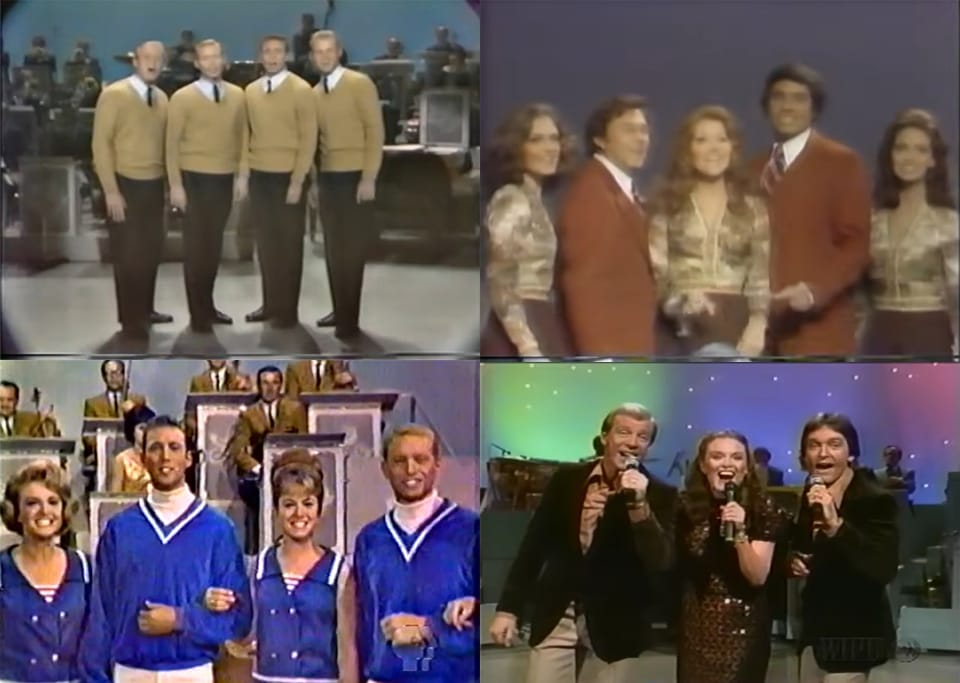
There is a know-it-when-you-see-it quality to the show, a bone-bleached whiteness that just, well, is. This is partly why, I'd guess, the jokes were as popular as they were: nobody ever needed them explained. To watch Lawrence Welk was to see both a white guy and a sort of white ethnography, and I mean that only a little facetiously. In her 1992 memoir, journalist Charlayne Hunter-Gault describes moving to Alaska in the 1950s and being the only black student in her eighth grade class. She writes: "The Physical Education Department used to teach square dancing, polkas, and schottisches, none of which I had ever done before coming to Alaska. Those were white folks' dances. At least I had seen Dale Evans and Roy Rogers square dancing. And I had seen white people on television dancing the polka as Lawrence Welk played in the background."
Welk found himself in rarefied comedy air. He was plainly, unassailably white without being overtly racist, and so one could reference him without "getting political," could discuss whiteness without the ugliness and hostility of supremacist ideology. He was extraordinarily popular and yet a consensus dud, so everybody knew who he was but agreed that he sucked. He was, in short, safe to make fun of. You were never going to insult anybody besides maybe your grandma.
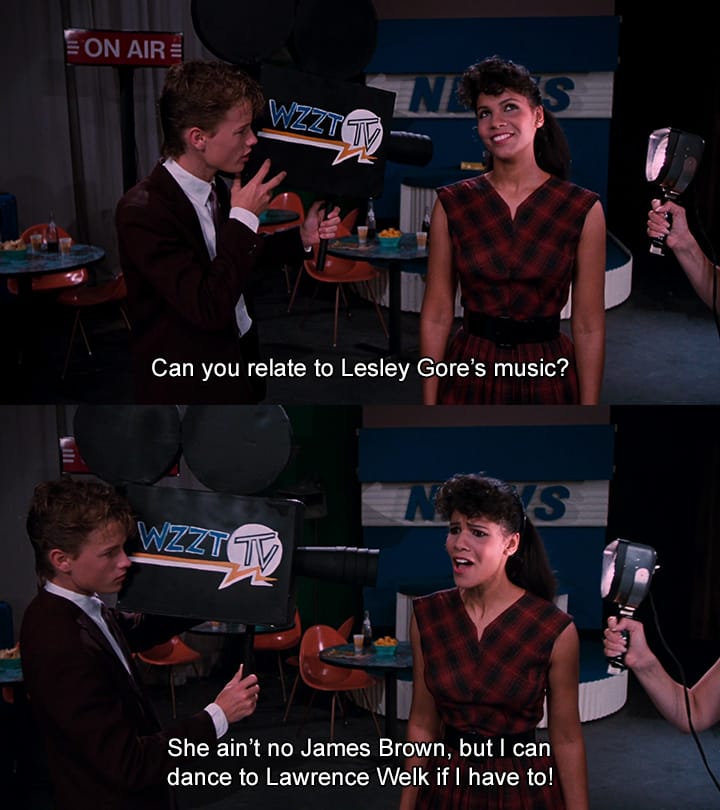
White people could therefore use Lawrence Welk as pool floaties in the otherwise treacherous waters of racial comedy. White comedians could indulge in self-effacing "We're so lame!"-style humor and, as long as they slipped in a reference to an "authentically" black artist, could smile and wink that, actually, we're hip to it too.
The Punchline
Unless it is impossible to discuss whiteness in some hazy, apolitical arena, where the coolness of black people and the squareness of whites are congenital quirks of otherwise equal people. Unless being that white is itself a kind of extremism whether or not one is "overtly" racist. Unless politics is inseparable from whiteness—or, more pointedly, unless whiteness is politics.
James Brown was often mentioned alongside Lawrence Welk as a counterpart, the rhythm to Welk's rigidity, the soul to Welk's sloth, and of course the black to Welk's white. It is true that James Brown (we can safely say) is a better musician and performer than Lawrence Welk. (James Brown versus Lawrence Welk is probably one of the most hydrogen-bomb-vs-coughing-baby matchups imaginable.) But this is not just a question of musical talent.
"The difference between James Brown and Lawrence Welk," said writer Amiri Baraka in 1970,"is not theoretical." Black creatives represent a distinct line of tradition and culture, and black Americans have long debated how that culture intersects with the broader American culture and how much black entertainers should appease a system that has abused and exploited them. Welk represented that system, and beyond a joke he was regarded as everything from an obnoxious mainstay to a macabre totem of injustice.
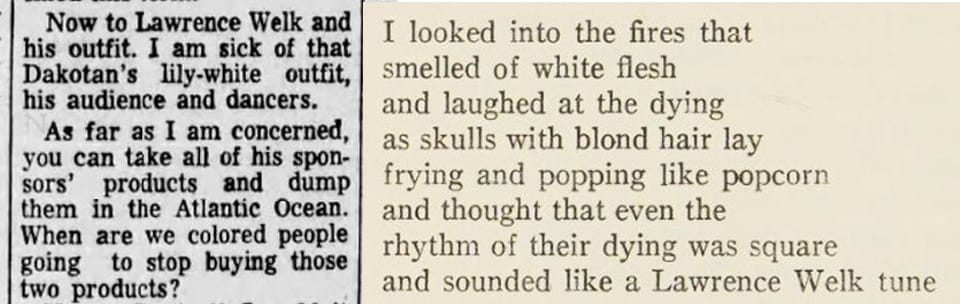
One could obviously spend lifetimes studying the history of anti-black racism and different schools of black liberation. The black nationalism movements of the 60s and 70s, in which Amiri Baraka was influential, is an entire field of study. But let's focus as clearly as we can on one consequential period for black comedians: the 1930s to the 1980s.
Black Out Loud, by journalist Geoff Bennett, describes the history of black comedians from Vaudeville performers of the late 19th century to the explosion of black-led media in the 1980s and 90s. The "Out Loud" in the title is a reference to the mainstream success of performers like Redd Foxx and Flip Wilson as well as the emergence of black stories in a culture that had long suppressed them. The American public grew more tolerant of black entertainers and eventually came to demand black representation in media, particularly in the wake of the Civil Rights Movement.
Bennett details this process of black life moving from the "private" to the "public" within the realm of comedy, as black comedians incorporated more of their actual lives and beliefs into their material rather than performing the (often demeaning) material white audiences expected. Black entertainers made many compromises to succeed, too many to summarize here, but one common experience was having to perform "black" material written by white writers. The episode of Good Times shown above, for example, is credited to three white guys.
The stories of these comedians are also about their refusals to compromise, their insistence on their talent despite every imaginable hurdle. Bennett avoids the feel-good framing of black people succeeding through hard work and turn-the-other-cheek perseverance. The book covers the difficult, sometimes criminal lives these comedians lived as well as the debates among black professionals with varied goals—art and activism, celebrity and wealth, sometimes just a steady job. The 30s to the 80s in particular was a period of stark transition, spanning figures like Stepin Fetchit (a relic of vaudeville ugliness who performed into the 70s) to Eddie Murphy (who was the biggest star in the country in his heyday).
This period, coincidentally, perfectly overlaps with Lawrence Welk's national career. This specific bandleader, by historical chance, lived and worked and got famous during a period of profound social change in the United States, when Americans witnessed the ascension of many black celebrities and had constant need for a humorous example of someone contrastingly white.
This, I think, is a big reason Welk endured as the go-to reference for a lame white guy. During this period of cultural upheaval, when someone not particularly long-lived could witness comedy evolve from unashamed minstrelsy to Richard Pryor: Live in Concert, Welk held fast. As new black entertainers burst onto the scene, one never had to update their reference for the whitest guy on TV.
So maybe Welk's popularity was not so coincidental. Welk's longevity, I would argue, his resistance to change, and his adherence to white Americans' sense of tradition reinforced an aura of whiteness that was already operating at near Super Saiyan levels. And that aura was not theoretical either: historian Frank Kofsky tells the stories of black musicians Miles Davis and Cecil Taylor getting publicly assaulted after performances. "What would have been the reaction," Kofsky asks, "had these brutalities been inflicted on, for instance, Leonard Bernstein or, for that matter, Lawrence Welk?"
That person above, the one who could have witnessed the change from minstrel comedy to Richard Pryor, didn't have to witness any change at all. That person could have averted their eyes and watched Lawrence Welk every week, then more on reruns, until the day they died. Given the size of Welk's audience, one imagines at least a few people did, sinking into their recliners as the last bubble popped.
Postscript
This is my twelfth post and therefore marks a year of this blog. Hooray! It has been very fun and rewarding and I have runway for many years more. This blog is promoted purely by word of mouth, so if you enjoy it, please share with friends, followers, colleagues, associates, rivals-to-lovers, and your many scheming viziers. Email subscriptions and RSS are the most reliable ways to follow.
Regarding the Amiri Baraka quote above: The man was an influential writer and also left behind a disturbing record of comments regarding women, gay people, and Jewish people. It is beyond the scope of this essay to interrogate his legacy, but it seemed remiss not to provide this context.
An interesting piece of research I thought worth including here: in a 1999 Lawrence Welk clip show titled "Songs of Faith," a guest host, perhaps aware of Welk's racialized reputation, delivers a monologue about the tradition of black religious music and states, "Our sacred music is richer because much of it was inspired by spirituals and blues traditions." One still wonders who "our" refers to.
A final note: Welk was also an author. (Deserving of air-quotes. All his books credit a cowriter.) His writing leans heavily into the American Dream-style life—his biography is that of a rags-to-riches German immigrant. He credits hard work, positive thinking, capitalist industry, and American pluralism. In one book, he describes the diversity of his own band as a miniature model of America's melting pot. In another book, he includes an analogy so outrageously on the nose for this essay that I couldn't bring myself to use it. I include it here as a bit of self indulgence. From Guidelines for Successful Living (1968):
It is said of a sales manager that during a particularly trying national economic period he called for a meeting of his salesmen from their far-flung territories.
In front of the assembly room he put a large white screen on which he placed a blot of black ink large enough to be plainly visible.
He asked his men to study the screen carefully and then tell him what they saw. One after another of them repeated that they saw a black spot. In spite of the manager’s urging that they observe the screen more carefully, the men came up with the same answer: a black ink blot.
Finally, in desperation, the manager said: “All of you see the black blot on the surface, but does not one of you see the large white surface?”
So it is with many of us in our daily living. We are keenly sensitive to the black spots, but close our eyes to the predominately white surface.
Below is a list of works quoted and other background reading not otherwise cited above.
- Baraka, Amiri. Conversations with Amiri Baraka. 1994.
- Hunter-Gault, Charlayne. In My Place. 1992.
- Kofsky, Frank. Black Nationalism and the Revolution in Music. 1970.
- Lamade, Paul. Altoona Tribune, 11/11/1938.
- "Lawrence Welk Variety Airer Will Be Outlet." Chicago Defender, 9/8/1956.
- MacDonald, J. Fred. Blacks and White TV: Afro-Americans in Television Since 1948. 1983.
- Rosenberg, Robert. Bill Cosby: The Changing Black Image. 1991. [Source of New York Times quote.]