Fat Kids Playing the Tuba

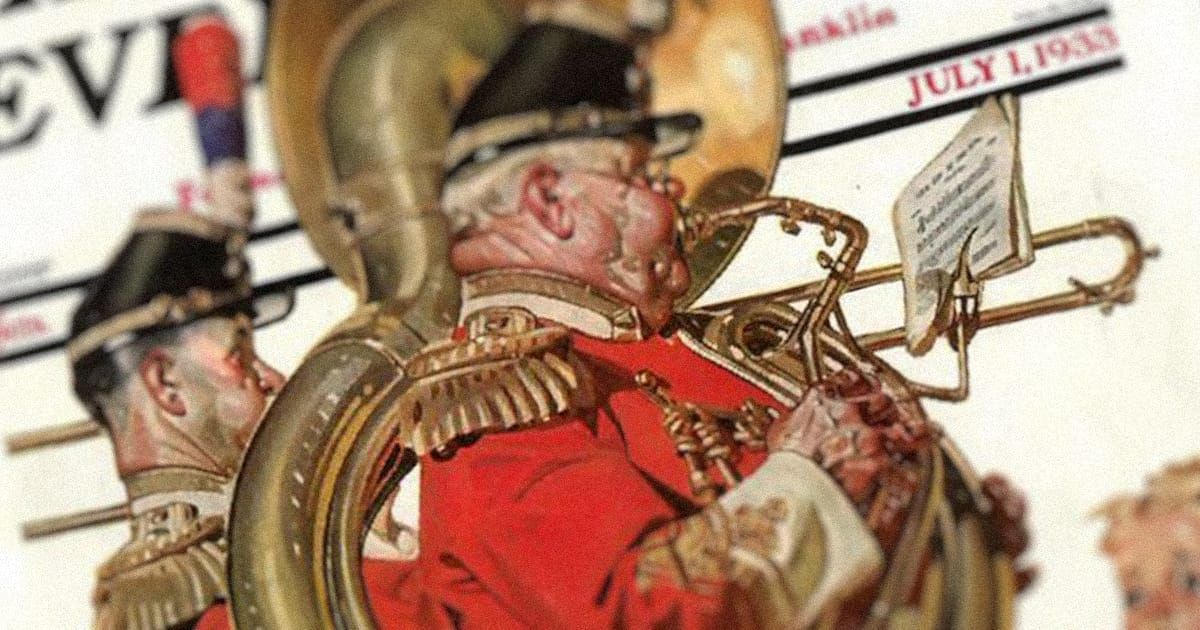
The Setup
“Boys. That was the primary reason why, in sixth grade, when I was handed a form with three blanks where I could list the instruments I wanted to play—any instrument, the whole band open to me—I put down “tuba” on the first line. I knew tuba players were historically male and stereotypically awkward, and as a girl who hadn’t yet lost her baby fat, I figured this just might bring me in contact with someone attainable.”
–Elizabeth Eshelman, “Tuba, or Not Tuba? That is the Question”
I believe, in researching this topic, I have taken the thesaurus entry for “fat” as far as it can go. These are but a sampling of the terms used to describe this particular member of the band: big, large, hefty, huge, husky, portly, pudgy, porcine, rotund, stout and plump, big-boned and well-fed. One writer referred to a marching band performer as “some chubby tuba player,” the performer’s fatness not affording him the dignity of the definite “the,” only the anonymous “some.” If you worry that the tuba player is unfairly teased for his weight, don’t worry: he’s also an uncool, untalented, undateable loser.
It is a rough life for the fat kid playing the tuba. Few characters so strongly represent an unenviable adolescence. Not only is the kid fat (terrible!), but the tuba is considered one of the silliest, least attractive, and least skillful instruments. The fat kid often does not even choose the tuba–it is chosen for him, resentfully, by adults obliged to care for an unfit, untalented, unenthusiastic ward. The tuba is the right field of instruments, an assignment for the kid who doesn’t matter.
Let us travel back, though, to a time when this detestable loser was merely German. Before being given to fat kids, the tuba was known to be played by jolly Germans, who already had a reputation for fatness among Europeans. “Mention the instrument,” wrote one reporter in the 1970s, “and a stereotype immediately comes to mind, usually of a rotund, beer-drinking member of a German band.” The instrument was in fact invented by two Germans in the 1830s before making its way to the rest of Europe and eventually becoming an orchestral standard.
Let’s dispense with an explanation that might have the feeling of truth: there is no actual, physical reason why fat people would be suited to the tuba. In my research, I found suggestions that the tuba is large and heavy and requires a lot of lung capacity, and so perhaps there are objective reasons why husky boys of history would gravitate to it. I believe this is no more than a pseudoscientific hunch, though one that has been long believed. A 1915 report on a beer-guzzling Dutch tuba player describes him as “barrel-shaped to a great extent, as tuba players often become, according to Dr. Taft, the ship's surgeon.”
Such theories, however appealing, fall apart under scrutiny. (The report above mentions the tuba player drank 34 mugs of beer during a single ship voyage, behavior that seems a more likely explanation for weight gain.) Many nonfat people throughout history have played the tuba and, certainly, being fat does not prevent someone from playing other instruments. Tuba players throughout the years have even spoken up about the stereotype, their fatphobia leading to campaigns against the image of the fat tuba player.
So as the image of the fat German solidifies, I think it is essentially arbitrary. There is perhaps something appealing about a fat man playing a tuba: it is a large, heavy instrument, and so perhaps it feels correct to see it in the hands of a large person. Perhaps tuba players appear fatter as a kind of illusion, holding an instrument that confers a large silhouette and requires the musician to constantly puff out his cheeks. But I think “the fat tuba player” is an accident of history, an image derived from musicians who happened to be fat and captured the public imagination.
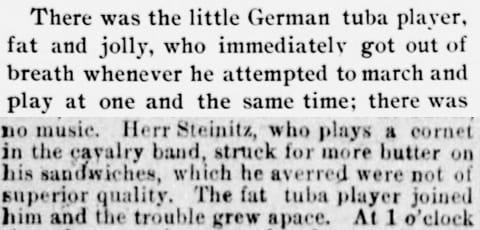
Many early references to German tuba players reinforce the stereotype. Reporters loved to highlight fat tuba players if they saw them or to exploit the stereotype as an easy way to add character to a story. I suspect many writers throughout the years have taken creative liberties in their descriptions of orchestras–a merrily round German pops off the page more than a pit of indistinguishable tuxedo-clad men.
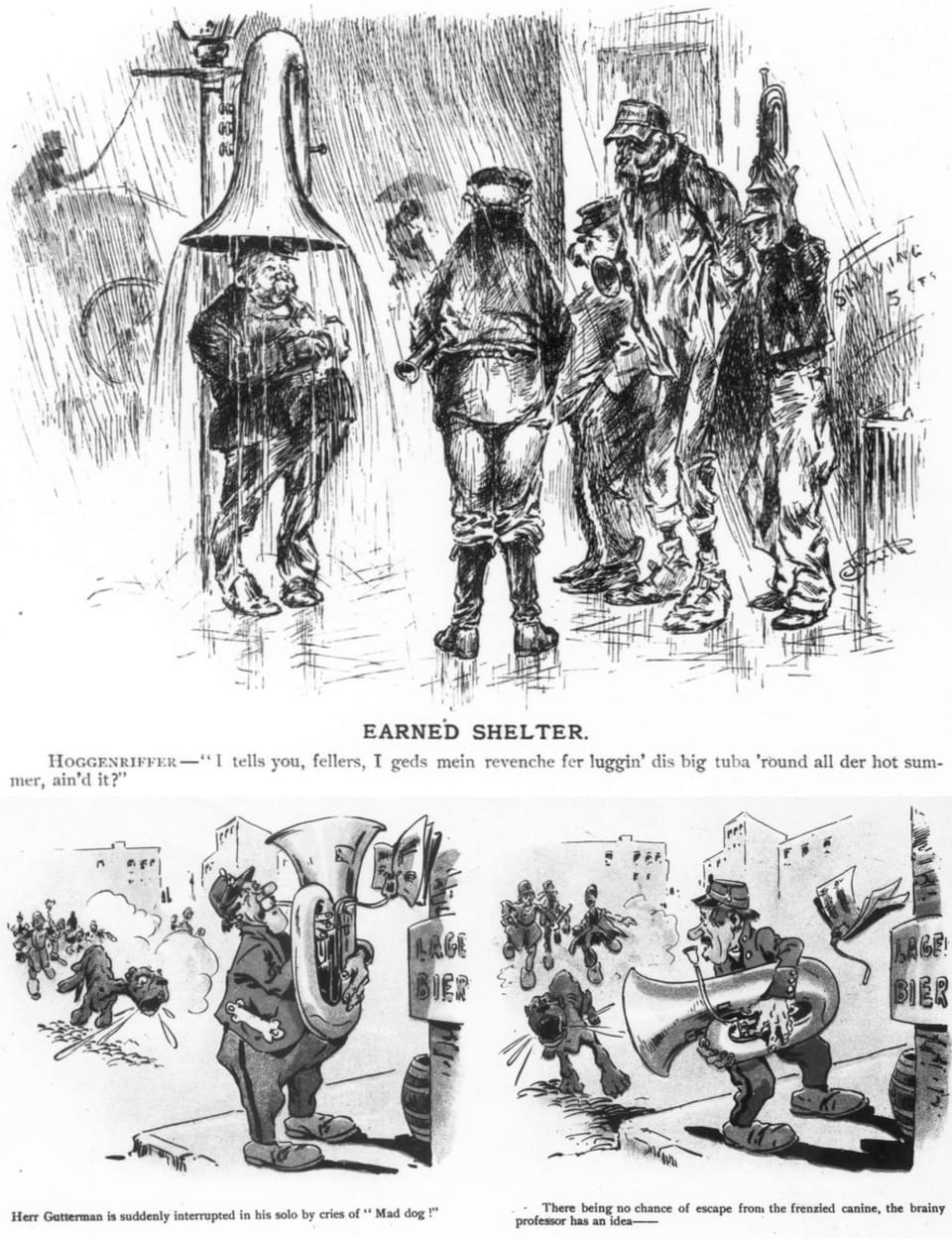
The fat German was well known enough to make the leap to comedic archetype. In the 1890s, the comedy magazine Judge featured comics starring characters with the cartoonishly Teutonic names Gutterman and Hoggenriffer. Though neither comic makes a punchline of the tuba players’ weights, the characters are clearly larger than others around them. Their fatness is core to their design even when it is unrelated to the joke.
The German-ness of this character would fade, however, as the popularity of band music both endured and transformed in national character. No longer was it a European import: The United States emerged as a leader in marching band music due to the popularity of composer and bandleader John Philip Sousa.
Sousa is the kind of composer whose music you know even if you don’t know. It has become, if anything, something of a historical cliche to mention him, an oft repeated piece of trivia that basically all famous American marches were composed by a single man. Songs like “The Stars and Stripes Forever” and “The Washington Post” are immediately recognizable, summoning images of marching bands and parades and sometimes used ironically to evoke gormless patriotism. (“The Stars and Stripes Forever” plays over the last scene of the film adaptation of Catch-22.)
What is less obvious to the modern ear is that compositions like Sousa’s were the popular music of the era. At the turn of the 20th century, Sousa and the United States Marine Band released hundreds of recordings, and Sousa himself toured the globe for decades. According to a PBS biography, Sousa led “the most admired American band of its time” and was a kind of early “recording star.”
And throughout all this, tuba players were still fat. The weight and size of tuba players were mentioned whenever possible, as if an obligatory detail, and the fat tuba player was now strictly a joke about that fatness. Gone was any regional origin or behavioral explanation; the tuba player was not German or beer-swilling. He was simply overweight, as in this unsubtle joke from 1912:

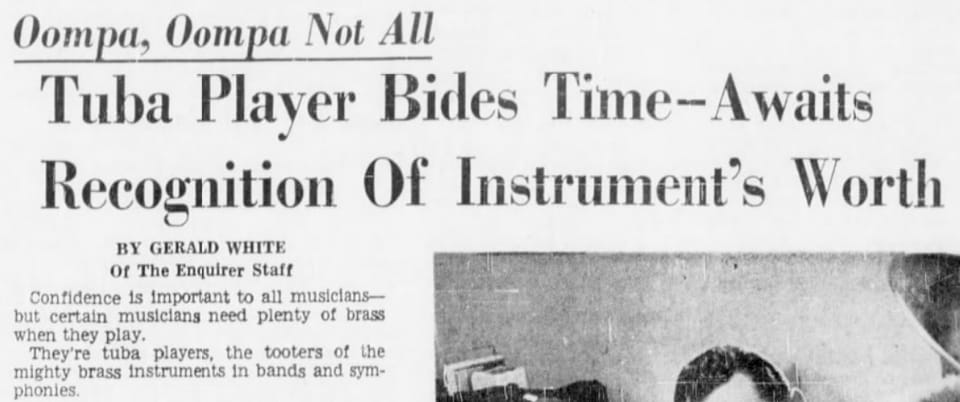
We also get the inklings of what would become a second dimension to tuba jokes: the instrument is fucking annoying. It is loud, bassy, silly, and usually meant to be heard in orchestration, not isolation. A story in a 1954 of the comedy magazine Ya-Hoo, for example, describes an unlikeable character as having been “thrown out of more rooming houses than a tuba player with the bubonic plague.” I was especially delighted to find a front-page(!) story in a 1964 newspaper about how nobody likes tuba players, that audiences and conductors and even fellow orchestra members are joined in an “unholy alliance” against the pitiable tubist:
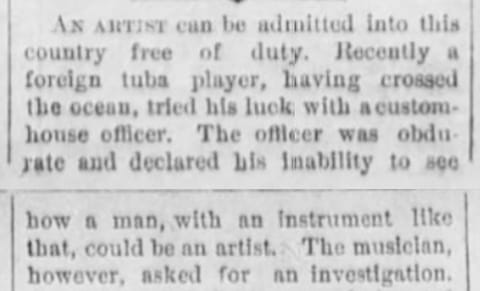
This sense of derision started early. A report in 1890 made the rounds in newspapers across the US about a foreign tuba player detained by customs. Artists at the time could enter the country without paying duties. One tuba player, however, did not strike a customs officer as such an artist. How could a man “with an instrument like that” be an artist? The story ends with the tuba player proving his musicality, but the joke is clear: a violinist or a flautist or I suspect even a contrabassoonist would have passed customs without incident.
But, as all human beings alive today know, band music’s incredible popularity started to wane. The music of John Philip Sousa would “soon-sa” collide with the popular culture of the 20th century: of radio and film and frankly much better music. The jangly rhythms of ragtime would become the inscrutable rhythms of jazz, and eventually before us would be set the great charcuterie board of popular music genres, and nobody wants to see marching band music served at a dinner party.
Children kept playing that shit, though. Students need activities, and activity-based camps, according to one 1929 newspaper, spread “with the wild fire rapidity customary with ideas in America that take the popular fancy.” Band camps date to at least the 1920s, and as far as I can tell they have always been the destination for America’s dorky youth. A 1940 report on “A Day at the Band Camp” describes a class of 75 campers “enjoying the double advantage of vacationing and studying,” one of the most wedgie-able statements I’ve ever heard.
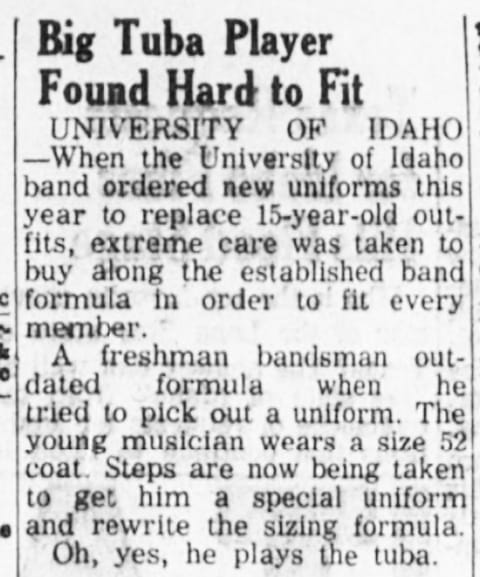
And yes, it was still considered funny to simply see a fat tuba player. No other joke necessary–if he’s big and plays the tuba, that’s a laugh. This 1962 article trades on the stereotype from a century prior, the German professional having fully become the American student:
The Punchline
Marching band is uncool for many reasons, the presence of cooler genres perhaps chief among them. Pick any time period from the 1920s onward and there is more attractive music for teenagers to perform: jazz, folk, rock, rap, even (somehow) ska. A 1967 editorial titled “No Weight Problem for Tuba Tooter” tries to rehab the tuba player’s image, acknowledging that “many of today’s youth prefer to learn the guitar or piano for those…folk song gatherings,” but don’t write off the “hearty souls” who choose the tuba (and aren’t fat).
But fatphobia runs deep, and fat kids know that theirs is a poison touch. Anything a fat kid can do is considered, by virtue of its accessibility, less hip. The fact that marching band accepts fat kids and others from the social margins is now a defining feature, arguably the defining feature, more than the music or the choreography or the uniforms. As a 2025 New Yorker feature puts it:
Marching band is the great remainder bin of American adolescence. It may be the most popular of all high-school activities, and the most indiscriminate. There are no benched players, no roster cuts, no restrictions based on size, skill, looks, or gender. If you can’t play an instrument, you can wave a flag or toss a baton. A teen-ager’s life can feel relentlessly Darwinian. From the moment you arrive at school, you’re tagged and sorted by degrees of intelligence, charisma, beauty, and brawn. But the band takes all comers.
“Band geeks,” as we’ve discussed, have long existed, but that term came to prominence in the 1980s when jocks vs nerds was seemingly one of the country’s most urgent domestic issues. However inflated the image was by movies and TV (one does not imagine most schools were like Revenge of the Nerds), band geeks were real targets of mean jokes and plain old bullying.
This dynamic was dramatized in Paul Feig’s 1999 TV series Freaks and Geeks. Freaks and Geeks is one of those legendarily short-lived shows that only found its audience post-cancellation on DVD. The show is set in the 1980 Detroit suburbs, and In one episode, Seth Rogen’s character Ken (one of the freaks) develops a crush on “Tuba Girl,” a marching band member named Amy (a definitive geek).

Specifically, Ken’s crush activates when Amy roasts him for being fat. The fatness of these characters (by TV standards) is made explicit, and Ken’s brain lights on fire when he confronts a girl who can give it better than he can. It is the kind of scene that makes Freaks and Geeks such a treat, allowing characters up and down the social ladder to tease and flirt with each other.

To emphasize that marching band is a home for social outliers, Amy eventually reveals she is what we’d now call an intersex girl, sending Ken into a brief tizzy (he contemplates whether this makes him gay) before realizing that the nature of her private parts doesn’t change their love for each other. One has to perhaps grade these episodes on a curve for 1999. The writers go out of their way to establish that Amy does not have a penis, for example, a detail that reads as gratuitously transphobic. But the show’s sympathies are clear and Ken’s hangups are presented as foolish.
Amy is a fictional character, but if anything her dramatized bullying pales in comparison to the real-life abuse faced by student musicians. We do not have to look far for contemporary records of name-calling and worse from other students and even adults.
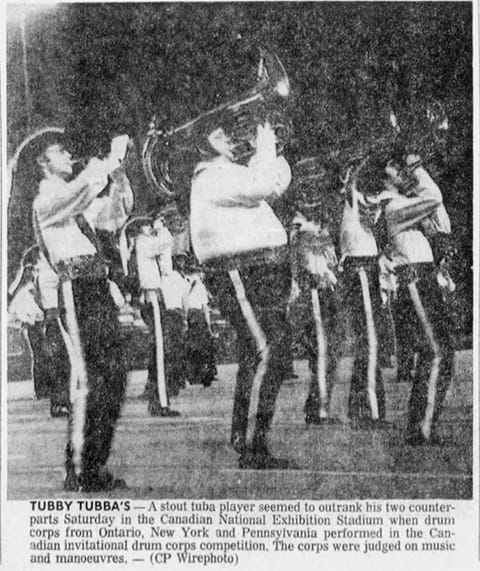
A newspaper in Thousand Oaks, CA, reported in 1982 that music and arts programs were under threat in local high schools, and parents would join in the heckling. In one district, “many students and some parents who are not involved in instrumental music 'make insensitive, stupid remarks' about band members, and sometimes call them 'band geeks.'” Examples abound of newspapers–actual newspapers–simply reporting on the existence of fat tuba players, like this 1974 Canadian paper that saw fit to print a photo with no justification besides “get a load of this fat guy”:
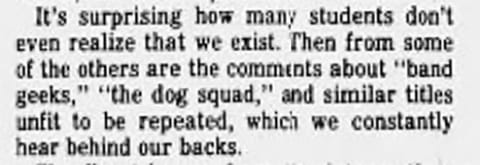
Indeed, a real-life Amy from Thousand Oaks wrote a letter to the editor in 1981. She wrote in defense of marching bands and drill teams, describing the toil and pain of “hours of practice” only to be ignored or derided at school:
Almost 50 years on from Amy’s letter, the fat tuba player is a stereotype still with us and unlikely to go anywhere any time soon. “Following fat people with a tuba” has become a recurring meme on shortform video (seemingly originating from a Family Guy joke) and the association between band geeks, and the tuba specifically, with losers is as enduring as ever. The seismic shifts in American culture that would be required for change, welcome though they might be, are invisibly distant.
There is also, I dare say, a harsh truth to be faced: to the extent that anything can be objectively, scientifically uncool, the tuba is uncool. Marching band has in fact been less cool than jazz and rock and (somehow) ska. As long as tuba players have been the butts of jokes, they have tried to spin their unpopularity into dignified perseverance. I could have ended this post with any number of quotes from band geeks, tuba players specifically, achieving some triumph or catharsis. Here’s one from a Grand Rapids newspaper in 1987 about a high school band that won a national competition:
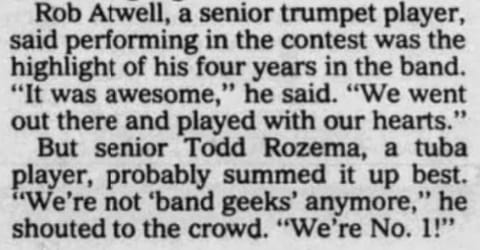
What a comfort it would be to end a story that way, to conclude that a musician tooting history’s fartiest instrument was, if you think about it, actually as cool as even a middling player of acoustic guitar. How nice it would be if the laborious practice of a difficult skill resulted in corresponding social approval. This is the fantasy at the end of many stories about unpopular kids, the revenge so satisfyingly enacted by the nerds. I think the unpopular kids know in their heart, though, that there is a much truer conclusion–and god bless them, because that’s most of us.

Postscript
If you enjoyed this post, please consider subscribing to this blog or adding it to your RSS feed.
Researching this topic produced no shortage of delightful historical trivia that did not find its way into the final post. Warren G. Harding, for instance, was a tuba player and video survives of our 29th president jamming out.
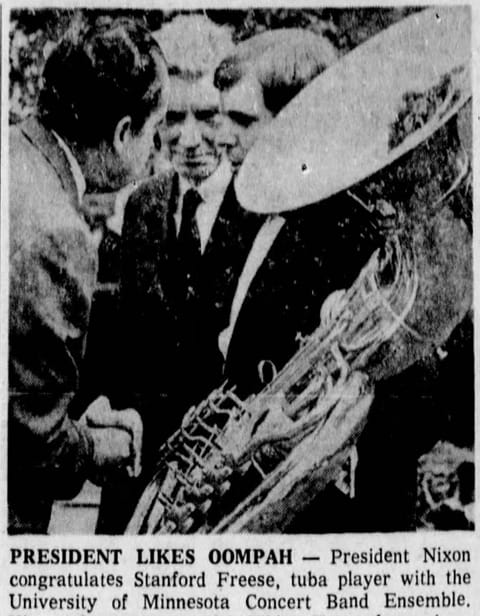
I am compelled to share a minor story from the Nixon years. In 1969, a university band performed at the White House and Nixon was apparently so taken with the tuba player that he congratulated the musician personally. The Soviet ambassador, also at the concert, took the opportunity to razz the US. He joked that the State Department should hire the tuba player because "he knows his notes better than the way we understand our diplomatic notes."
I would add that Richard Nixon being a big-time tuba fan does no favors for band geeks trying to escape their uncool reputation.
Below is a list of works quoted and other background reading not otherwise cited above.
- Banas, Casey. "Tuba Players, Unite!" The Blade, 3/20/1977.
- "250 Youthful Musicians Are At Band Camp." Richmond Times-Dispatch, 9/15/1929.
- "A Day at the Band Camp." The Democrat-Leader, 8/16/1940.
- Bilger, Burkhard. "High-School Band Contests Turn Marching into a Sport—And an Art." New Yorker, 2/10/2025.
- Esehlman, Elizabeth. "Tuba, or Not Tuba? That Is The Question." McSweeney's Internet Tendency, 9/26/2013.
- Gaugh, Catherine. "Schools struggling to keep music, drama, arts in curriculum." Thousand Oaks Star, 5/27/1982.
- Lowe, Hal. "No Weight Problem for Tuba Tooter." Long Beach Independent, 10/19/1967.
- "Plays Tuba All Day Long." Iowa County Democrat, 4/15/1915.
- "Satan and Sam Faust." Ya-Hoo, Spring 1954.
- Wojnowski, Bob. "Michigan win would sae Buckeyes from humiliation in BC." Rockford Register Sun, 11/22/2002.