Wearing a Lampshade on Your Head

The Setup
“The third generic type of humor with a reputation for being inappropriate is the practical joke … To be labeled as a real practical joker is a career-demolishing fate. It brands one as a lowbrow possessing a lampshade-on-the-head sensibility–someone to be avoided at all costs.”
–The Light Touch: How to Use Humor for Business Success (1990)
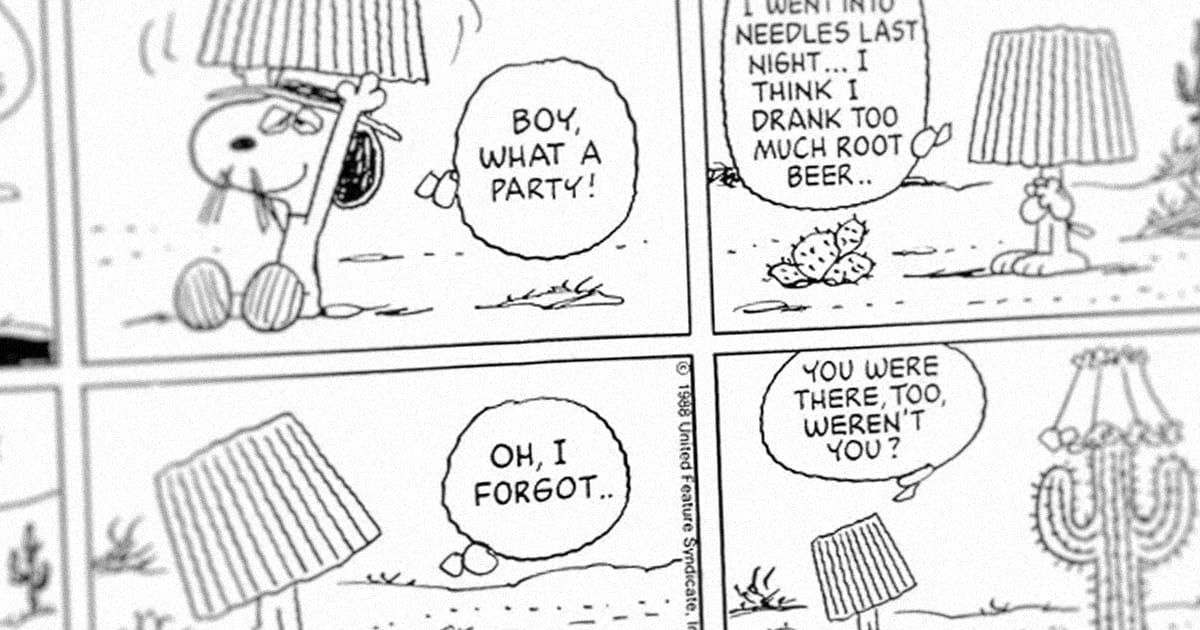
The lampshade on the head is a joke well past its prime, so much that I wonder how much time will pass before it is no longer recognizable even as a cliché. In 2026, you have to be very old to have lived when a lampshade on the head aroused a sincere laugh. It is an old-fashioned symbol of drunkenness and rowdiness and the kind of inebriated disorder that symbolizes not the start of a party but its impending conclusion. When I began to research this topic, I found many comments unsure of its origin but assuming it stems from vaudeville–it radiates the stink lines of age.
More likely, if a 21st century reader associates the lampshade on the head with anything, it is with the obliviously uncool. It is the refuge of the dope, the kind of joke deployed by a guy who sucks, does not know he sucks, and worse yet has clocked you as someone who shares his sense of humor and therefore also sucks. He is embarrassing himself and by association everyone else in the room–after all, you all apparently go to the same parties.
It is no wonder that Michael Scott, one of the most famous “guys who suck” in comedy history, wore a lampshade in 2005’s Christmas episode of The Office. The gag, of course, is that even by the standards of the moment Michael Scott is an outrageously out-of-touch boor. And now this episode is over 20 years old. (Apologies to my middle-aged readers for this fact.) I don’t think this joke would work any more–it would be too ironic, too obviously the invention of a screenwriter.
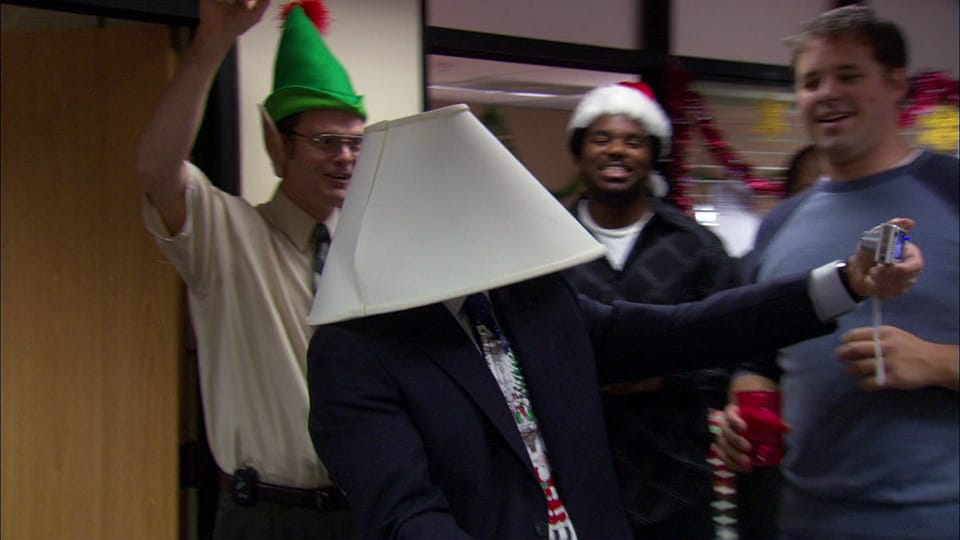
As that episode of The Office demonstrates, the lampshade-on-head is well established as a “trope”–the preferred term for cliché these days–with websites like TV Tropes listing numerous instances of the joke. Despite abundant examples, the joke’s origin was harder to trace, and I could find no definitive history. A 2009 Slate writer took a stab, dating the joke to at least Charlie Chaplin’s 1917 film The Adventurer. Jumping off from that, I’ve found it goes back much further. And as good a guess as it is, the joke is not from vaudeville either.
Fashion historians may already be slapping their foreheads–how could these morons not have made this connection?–but when we talk about wearing lampshades as hats we have to discuss the real-life “lampshade hats” that were popular in the late 19th century and into the early 20th. These elaborate wide-brimmed hats not only resembled lampshades but were called exactly that. The term “lampshade hat” was widespread as both a casual descriptor and formal category. Fashion reporters and advertisements used the term.
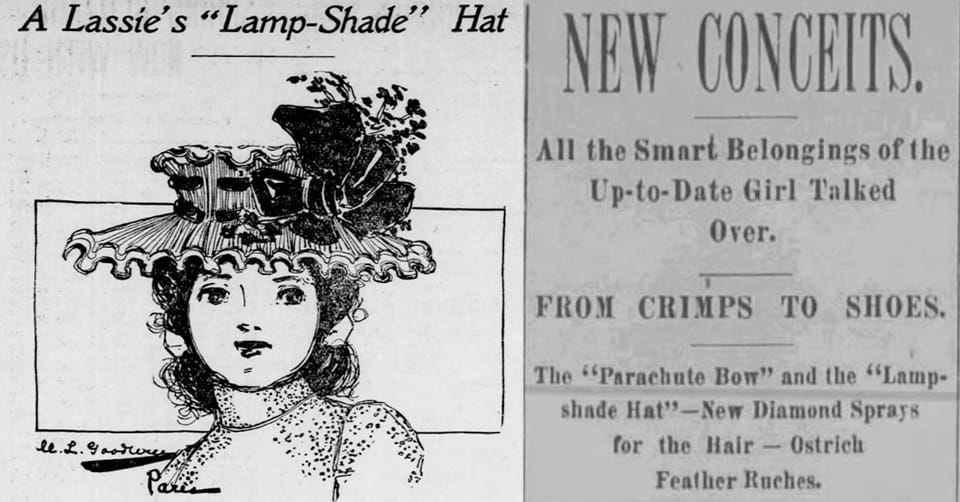
It’s beyond our scope to discuss the trajectories of lampshade hats as fashion. Trends ebbed and flowed, moving through Europe to the United States. In 1886 the Philadelphia Times called lampshade hats “the latest Parisian novelty,” but fashion moved slower back then and the hats trended in different cities at different times. The term has also long described the conical hats worn across Asia (known by different names in different languages).
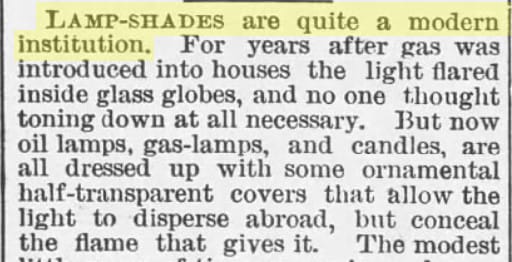
Obviously, hats with wide brims were not new in the 19th century. But the term “lampshade hat” can’t have been much older for the simple reason that lampshades were kind of a new thing. Premodern lamps had hoods and ways to direct and contain light, but lamp technology progressed rapidly in the 19th century, and electric lamps made their debut circa 1870. It wasn’t until the latter half of the 1800s that lampshades were a common sight. (Consider the fire hazards that lampshades could pose with open-flame lamps, and you can find reports from the era of fires started by lampshades.) One newspaper called lampshades a “modern institution” as late as 1889.
For decades across the 19th and 20th centuries, comedians poked fun at the similarities between high fashion and household decor. Then, as now, people and in particular men loved to deflate the pretensions of chic urbanites. There were countless jokes based on mistaking a woman’s hat for a lampshade, ranging from clever visual gags to blunt statements. “Women always be wearing funny hats,” was, for a while, a go-to observation of modern culture.
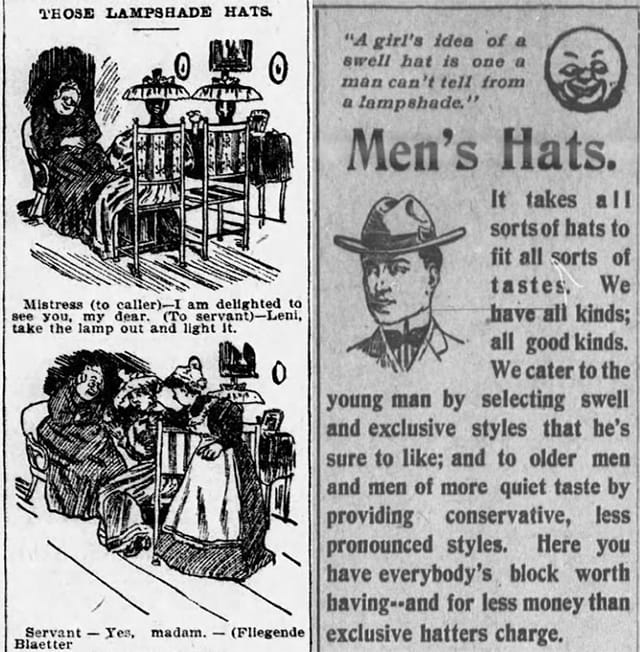
A couple of examples will paint the picture. An 1896 newspaper comic shows that these comparisons were unambiguous. “Men baffled by women’s clothing” is an old genre of comedy, predating the 1890s and continuing today, but at that time the lampshade hat was the topic du jour. These hats didn’t kind of look like lampshades–they were so similar as to be confusing. This observation was so common that it made its way into the great retirement home for jokes: advertising. In 1902, a hatter included a lampshade quip at the top of an ad that makes it clear that women’s hats are silly (but men’s hats are swell).
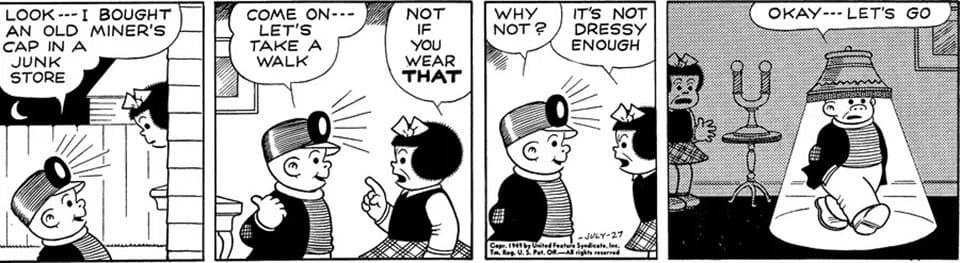
The great Ernie Bushmiller shows us how far this joke persisted. Men confusing the lampshade for high fashion was still a joke you’d see in the daily newspaper as late as the 1940s. This Nancy comic was published on July 27, 1949. The fact that Sluggo wears an “old” miner’s cap makes it possible that Bushmiller was poking fun at the joke being a little old itself. (Bushmiller-era Nancy was often self-aware.)
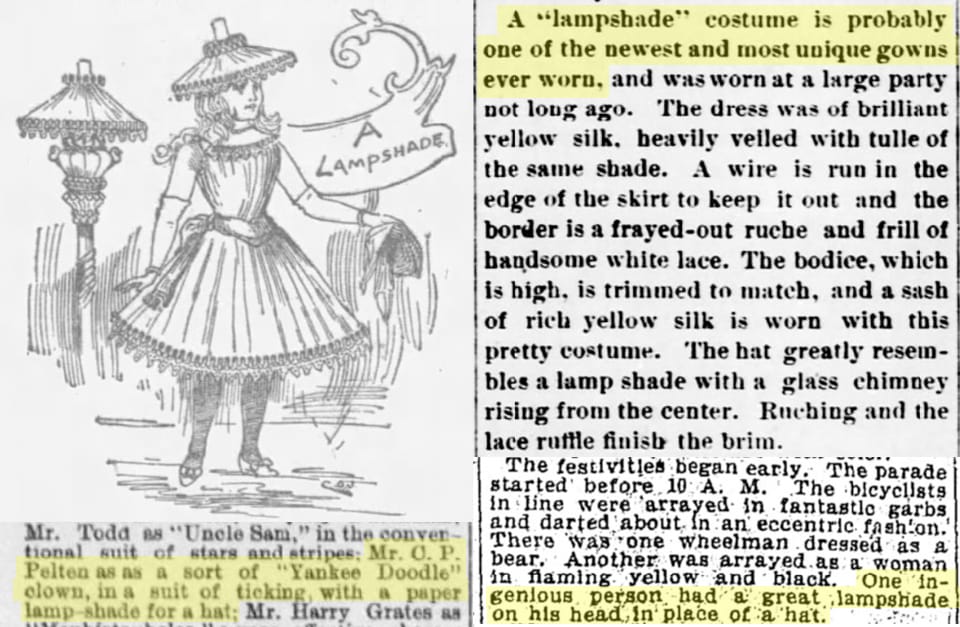
It was not all dopey men mocking fashionable women, though. Remember that the lampshade was a modern novelty. I found many examples of people dressed in lampshades at various parties, masques, and balls, sometimes dressing specifically as “a lamp” and other times donning the lampshade as a low-effort accessory. Based on the number of stories I’ve found, I get the impression it was a fad, the kind of costume you’d find prepackaged at an 1890s Spirit Halloween if such a thing existed. (Imagine how far we would have come as a civilization if Spirit Halloween had been founded a century earlier.)
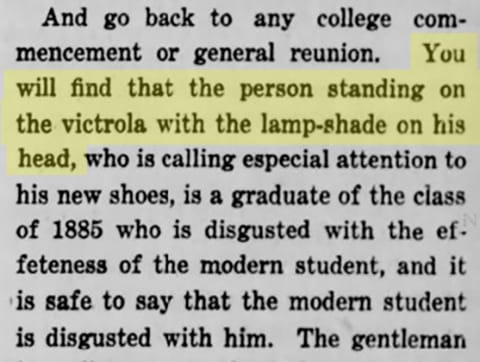
Because the lampshade was common at parties, I think it’s safe to assume its association with rowdiness and drinking goes back this far as well. In particular, wearing lampshades seems to have been popular among students in the US and abroad. A British newspaper in 1917 discussed a 50-year-old man reminiscing about "when he was an undergrad and wore a lamp-shade upon his head” (Sunday Dispatch, 11/25/1917)–which, if you do the math, would date that behavior to the mid-1880s. A 1916 American report about aging alumni paints a picture of a grad of 1885 embarrassing himself at a reunion, seemingly donning the lampshade as a throwback to the good old days.
But let’s not get too bogged down in the details. The obvious must be stated: it’s funny when someone wears something silly on their head, and a lampshade does kind of look like a hat. Someone somewhere was the “first” to wear a lampshade, but undoubtedly many people invented the joke, needing little more inspiration than proximity to a lampshade and, often, lots of booze.
The earliest example of the joke I can find is just that–a drunk making a mistake. In 1870, a variety of English newspapers reported the same story of an American’s misadventures in New York City. English newspapers stated that the story came from US newspapers, though I haven’t been able to track down any local reports.
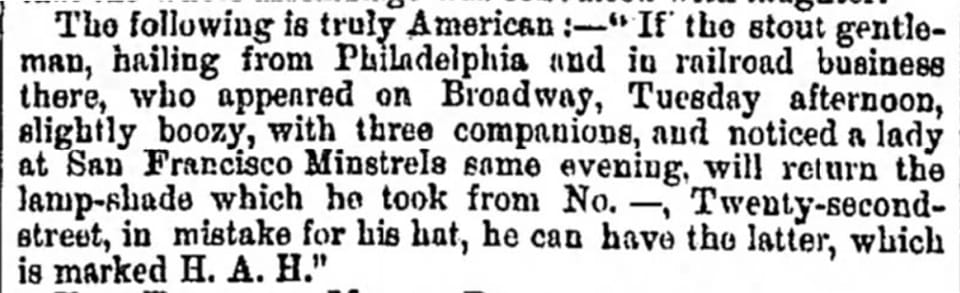
This story is possibly a comic invention or embellished tale (the initials H.A.H. certainly seem suspicious), but it is presented as truth and has at least the faint ring of such. The San Francisco Minstrels were a real and incredibly popular blackface troupe, and local listings confirm they did play a show on Broadway the day this man supposedly mistook a lampshade for a hat.
Whether or not this story took place, I want to highlight the editorial note–”The following is truly American.” One English editor, at least, thought the story reflected something in the American personality, a national boorishness. As we’ll discuss, perhaps it did.
The Punchline
All this history is (to me at least) interesting, but these associations have long been lost. Nobody wearing a lampshade in 1970 was making fun of trends from a century prior. The lampshade-on-the-head was no longer novel and morphed into a generic party ritual. Humans drink a lot and party a lot, and the lampshade is a convenient signifier of those signifieds. Lampshades are conveniently grabbable in a host’s home and only became more conveniently grabbable as America electrified and suburbanized.
And, it turns out, it did not take long for the lampshade-on-the-head to morph further. It became a symbol not of the party animal but of the depressing suburban drunk. In 1958, Time printed a story about the comedian Jim Backus (the wealthy Mr. Howell from Gilligan’s Island and the voice of Mr. Magoo, among other roles). The article is titled “The Man in the Lampshade” and its perspective on such a man is clear:
The voice is pure club-car American, rumbling through bourbon and cigar smoke, shaking with hoarse laughter. It sounds like a man imitating what he once feared he might become: a fat-ribbed salesman for his papa’s turbine plant. Rumbles James Gilmore Backus: “I left Cleveland to get away from His and Her towels, people who call cocktail parties ‘pours’ and the guy who always breaks it up by wearing a lampshade on his head."
The “lampshade boor,” as the article calls this kind of person, is an affront to those who cannot abide the tackiness of normal life. The Lampshade Boor represents the doldrums of a comfortable-but-uninspiring existence, someone for whom throwing on a lampshade is the highlight of their week. I must emphasize that this is a kind of person, not someone literally wearing a lampshade on the head. It would not take much longer for comedians to make jokes about how that doesn’t happen anymore, as in a 1975 Mad article titled “Has anybody ever really seen…”
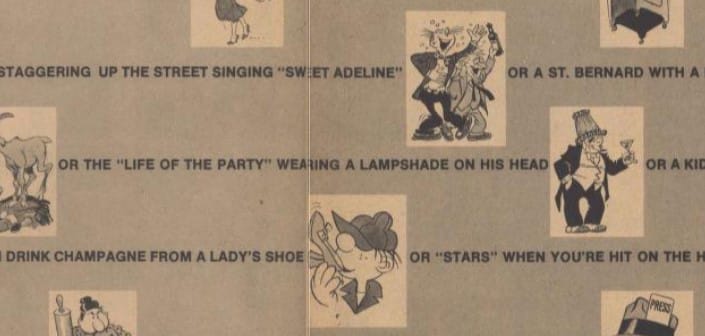
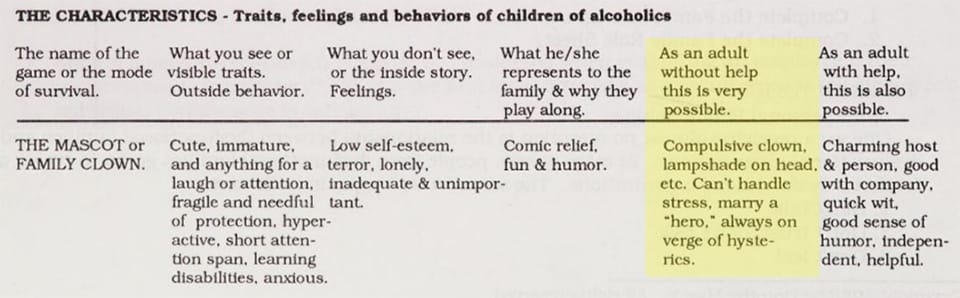
If the real-world behavior had vanished, what it represented did not. A 1974 novel called The Arousers uses the phrase “lampshade-on-the-head drearies in suburban America,” telling us exactly where these drearies reside. Phil Donahue’s 1979 memoir includes an anecdote about “a particularly loud lampshade-on-the-head guy telling bad jokes” (revealed to be a pathetic divorcee). One 1992 psychology book describes different coping mechanisms used by children of alcoholics. For children who cope by playing the “family clown,” becoming a lampshade-on-head-guy is listed as a worst-case scenario–explicitly a fate resulting from unmanaged trauma.
For all these harsh, sometimes villainous descriptions, the lampshade boor is not dangerous. He is not hurting anybody, not even himself (besides the occasional implication of alcoholism). He is not a predator nor an asshole nor particularly rude. The “joke” of the lampshade on the head is not crass or offensive–it’s just silly. You might argue, if anything, we’re being too mean to this guy, too arrogant.
Whether or not we're arrogant, the Lampshade Boor is someone you do not want to be. He is a forerunner of the suburban malaise that would haunt the baby boomers and radicalize Generation X, an uneasy suspicion that this might be all there is. This–the dreary suburban party–is enough, he has decided. He is content to perform this one gag over and over until he dies. He is the original American Cringe, so comfortable with a life of spiritual emptiness that it’s upsetting to behold.
The lampshade, by historical coincidence, came to symbolize this emptiness, transforming from a party trend into a weirdly sad metaphor. I like to think it’s a fitting metaphor, though. The lampshade on this man’s head accentuates what might be otherwise hard to notice: there’s no light behind his eyes. If there was, he’d glow.
Background reading
Beam, Christopher. "When Did Drunks Start Wearing Lampshades?" Slate. 2009.
"The Man in the Lampshade." Time. December 15, 1958.