Metrosexuals


The Setup
A feminized society instructs us to abandon all precepts that our thoughts, desires, and delights are any different at all from those of a woman. Do this and we are bestowed the title of society's flaccid favorite, the metrosexual. The newly favored man is not really a man at all, but a hairless, effeminate, germ-fearing, meatless-eating, exfoliating, wristband-wearing woman of the worst order.
–Man: The Book (which I swear is a comedy book despite this sounding like a manifesto) (2008)
The metrosexual trend was so famously that–a trend, something that came and went–that it might surprise you to learn the term was deployed fairly recently. In the halls of Congress, in fact, in utter seriousness.
In November 2022, Madison Cawthorn, then a republican congressman in his late 20s, took to the floor to state the following: “America is weak…Our young men are taught that weakness is a strength, that delicacy is desirable, and that being a soft metrosexual is more valuable than training the mind, body, and soul.”
Dire words. You would hardly believe they came from a man whose handwriting looks like he still holds his pencil in a closed fist.
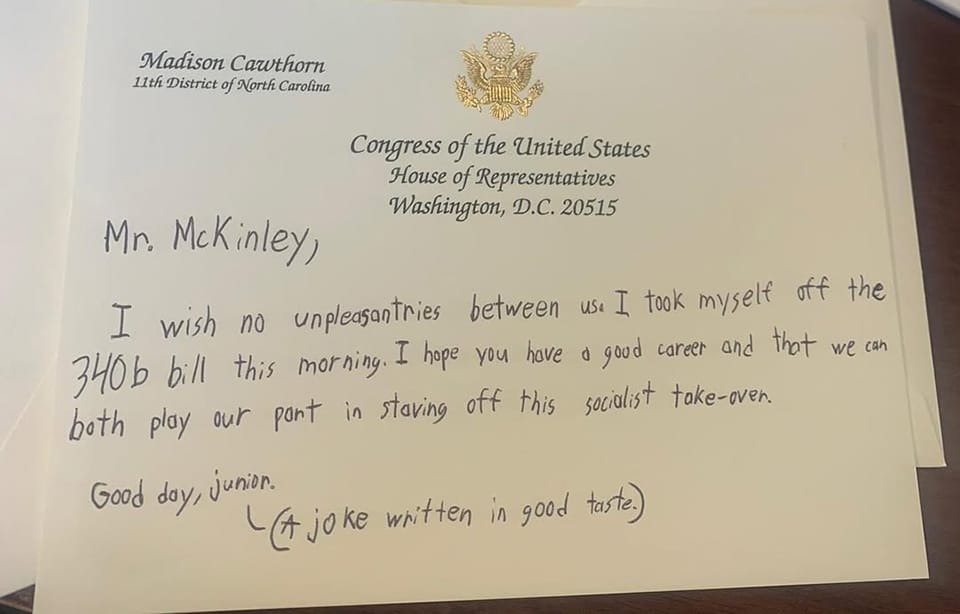
You might also find it hard to believe these words came from a man born in 1995. Cawthorn was literally not alive (even by his own at-conception standards) when metrosexual was coined. The term became a sensation in the US in 2002 when Cawthorn was still in single digits. By 2005, when Cawthorn was turning 10, the age of the metrosexual was reportedly over. Newspapers had turned to something new: the “ubersexual,” an ultra-manly reaction to prim metros. Remember that term, ubersexual–we’ll come back to it.
The high-level history of metrosexual is straightforward and uncontroversial. Its tidy explanation, I think, was part of its appeal: hundreds of writers could summarize the movement in virtually identical paragraphs. “Metrosexual,” the story goes, was invented by British journalist Mark Simpson in 1994 in an essay for The Independent titled “Here Come the Mirror Men” to describe a new kind of man who cares about his appearance and enjoys a well-to-do urban lifestyle. The catalyst for American interest (and by extension the rest of the world) came in 2002 when Simpson reintroduced the term in a Salon.com article titled “Meet the Metrosexual.”
Who, or what, is a metrosexual? I think some examples will help. Certain celebrities were frequently cited as metrosexual, and there was a long list of behaviors associated with the lifestyle.
People
David Beckham, Brad Pitt, Justin Timberlake, Spider-Man (as portrayed by Tobey Maguire), Patrick Bateman (as portrayed by Christian Bale)
Qualities
Straight, rich, single, urban, vain
Here it pays to be a little more detailed: Simpson was not describing a fashion trend but homing in on a specific masculine anxiety. Consumer capitalism (Simpson used this phrase verbatim) had for years given straight men a pass. They were not seen as shoppers–they did not control the household purse nor did they like shopping to begin with. Marketers had targeted women and gay men instead, and Simpson believed that gay men in particular had been test subjects for marketing tactics that would be refined and eventually aimed at heterosexual dudes.
The metrosexual trend, he argued, was that pivot: straight men were bombarded by “glossy” images of male vanity, not just conspicuously primped celebrities like David Beckham but also the nerdy-but-shredded Peter Parker. Body dysmorphia was too profitable a sales tactic, and now it had come for the straights.
If there was any doubt that Simpson was correct, a report from an ad agency called Euro RSCG would arrive to make Simpson’s point for him. This report, called “The Future of Men,” came out in 2003 and described an evolving sense of masculinity, of men who cared more about their partners and appearance. These men resented the traditional depiction of man as the household buffoon. This was no sociological survey: the purpose of this report was to better advertise to these men, to sell them more and costlier stuff.
But explaining Simpson’s argument is besides the point. The phenomenon as it would be known had nothing to do with Simpson’s original essays. (Like many people who coin a popular term, Simpson came to resent it.) Straight men had absolutely zero interest in discussing how they were now the laser-focused targets of extractive capital. The poor fellows barely had a chance: popular coverage of the metrosexual trend included none of Simpson’s critique, describing it merely as a fashion and marketing trend (and perhaps something threateningly European).
Rather, “metrosexual” exploded as a term of art for straight people, a word that filled a widening gap in the heterosexual lexicon. In the 2000s, it had become slightly harder to be publicly homophobic. Gay rights were on an upward trajectory and a lot of sturdy, reliable slurs were becoming impolite to say in mixed company. Metrosexuals, however, were not gay: they were straight, completely and definitively. That was the point. It was Queer Eye for the Straight Guy, let’s not forget.
Straight people were tickled beyond delight at having a new and polite word with which to describe the lightness of one’s loafers. You can’t call someone gay, but you can make fun of the fact that they moisturize or use too much hair gel or go to a gender-neutral salon. You could level some pretty horrible insults at a metrosexual without being a homophobe because you weren’t calling them gay, just…not acceptably straight, a kind of heterosexual class traitor. Comedy especially was a vector for this kind of commentary, with hard-consonant gay-bashing disguised as the self-deprecating observations of 21st-century straight men.
The 2003 South Park episode “South Park Is Gay!” pulled this exact trick. The metrosexual “fad” (the episode reminds us often it is a fad) comes to town, spread like a virus by the TV show Queer Eye. Virtually every male in town watches the show and is instantly transformed. Like blood from a stone, the writers squeeze 22 minutes of mincing-queer comedy out of this premise.
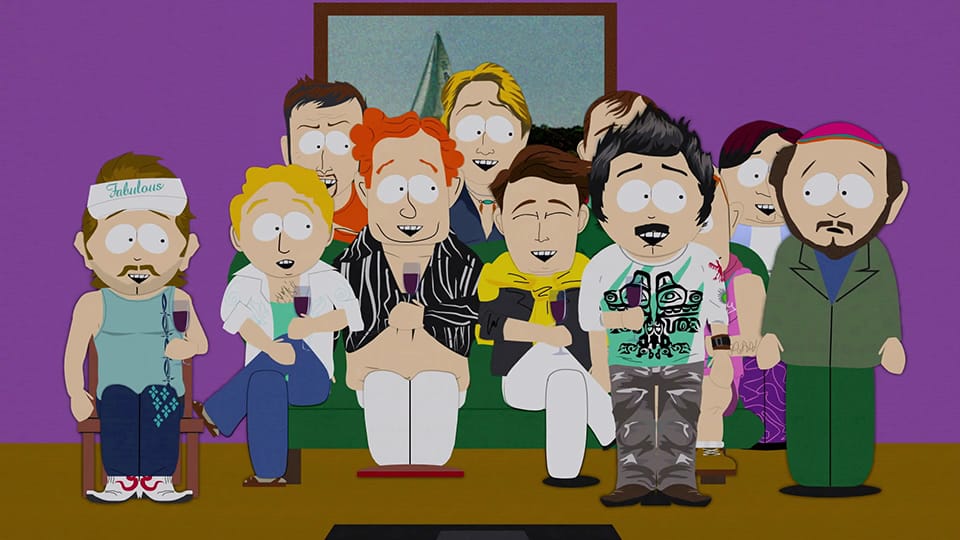
Lest you think the show is doing cheap gay humor, the writers position straight people as the villains (how modern). At one point, metrosexuals invade the local gay bar, deceiving the gay teacher Mr. Garrison into thinking that local dads are down for hookups. Mr. Garrison is the beset-upon gay man and metrosexuals the obnoxious interlopers. This was not an invention by South Park–it was a “real” concern of the time that queer-seeming straights would confuse bona fide gays. (I use quotes because I’m skeptical this was widespread. Straight people always flatter themselves that they’re capable of this.)
The show ends with the revelation that the Queer Eye hosts are not gay, nor even human, but crab people trying to take over the planet. Nonetheless, the women of South Park do not know this–they beat the hosts to death with baseball bats for the crime of making their husbands and children too gay. Despite not being gay or human, the Queer Eye hosts are killed while in their gay, human forms. Why the show decided to depict their deaths so graphically, I don’t know. I guess South Park’s comedy goes over my head.
This episode features plenty of metrosexual stereotypes and is a good excuse to continue the lists we started above. Who else was considered metrosexual in the mid-aughts? What sorts of behaviors were considered a little, you know, that way?
People
Jude Law, George Clooney, Ricky Martin, P. Diddy, Barack Obama
Qualities
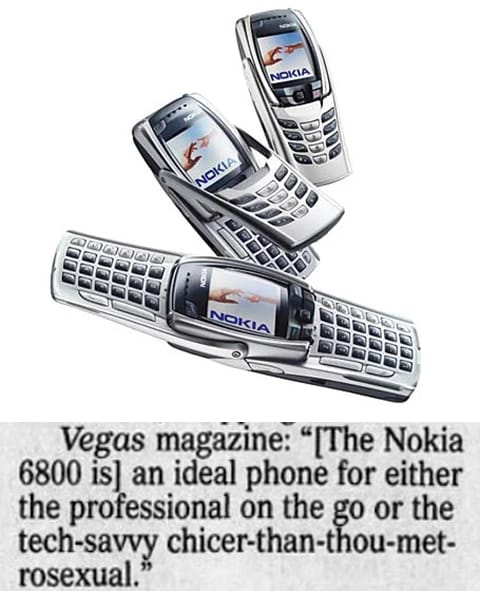
Wears pleated pants, wears scarves, drinks scotch, watches HGTV, uses the Nokia 6800
These are all real people and things someone considered metrosexual, and the list is now growing a little hazy. Jude Law, sure, he’s a pretty man. Clooney has always been rugged, though. Ricky Martin doesn’t really “count” because he’s actually gay, but he hadn’t come out yet, so I guess we let that slide. Metrosexuals were known for drinking pretentious cocktails with only top-shelf liquor (Grey Goose often mentioned as a preferred vodka), and at least one writer confusingly extended this to drinking Scotch–one of the manliest beverages I can think of. And as far as the Nokia 6800 goes, I have no idea. Pre-smart cell phones are now an esoteric branch of fashion history, and we can only take it for granted that this phone was effeminately hip.
Diddy is an unpleasant topic now but was a common example then, mentioned by many writers and one of the rare black celebrities considered a prominent metrosexual. That is, until a few years later and another extremely famous black man took the national spotlight. It’s worth taking a short detour to discuss Barack Obama even though he is a very late example.
Libraries are already being filled with books about the manias people experienced over our first black president. One of those manias was metrosexuality. Obama was called a metrosexual by all sides, with all the implications, positive and negative, that term carried. His opponents tried to paint him as young (bad) and urban (black, bad) and, of course, gay (bad). Obama’s supporters wanted to paint him as young (good) and urban (black, stylish) and, naturally, a little gay (progressive). He would, for example, appear in Geeky Dreamboats: A Celebration, a collection of adorkable celebs. Here, being a metrosexual is a positive trait intended to appeal to young straight women.
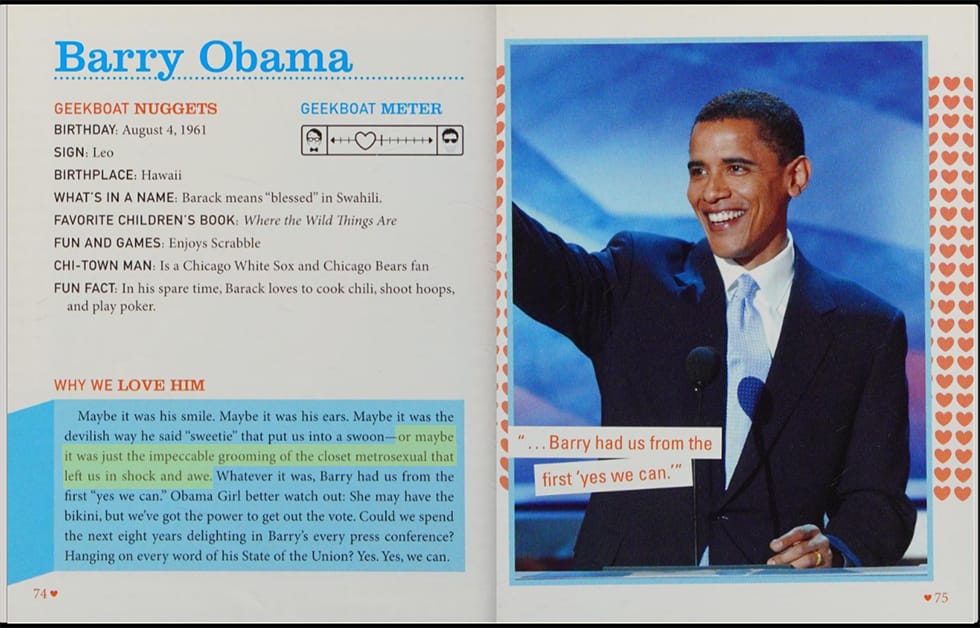
Maybe we shouldn’t be surprised that Obama was called a metrosexual. An irony of the metrosexual is that the image we remember–the muscular, well coiffed man in a loud outfit–is far more specific than how the term was actually used. Basically everything was metrosexual for a few years, and indeed it was catnip for the columnist who needed something to jaw on.
In my research, I found countless human interest stories where a reporter or news anchor went to a mall or a stylist or a nail salon to sample the metrosexual lifestyle. The protagonist was almost always a befuddled straight man who had no idea what this crazy new word meant, and every befuddled straight man had their own ideas of what qualified as metro. Washington Post columnist Richard Cohen (then in his 60s) asked “Am I metrosexual?” because he shined his shoes and went to the gym. Another op-ed writer wondered whether using aftershave counted (Eastern Wake News, 10/21/2004). Tongue in cheek or not, the gag was straight men overwhelmed by yet more gender vocabulary.
Maybe the metrosexual is someone too in love with themselves and their singleness? Or maybe they are self-hating heteros, “gay wannabes” in love with an ascendant gay culture? Someone who will one day be punished for their vanity, tossed aside by narcissistic queer men when they could have lived in the nurturing embrace of straightness.
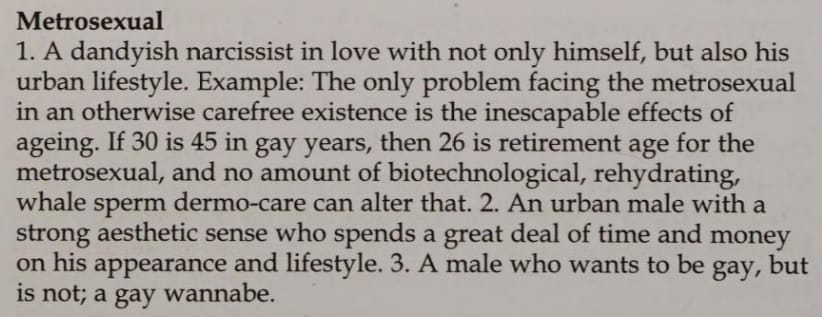
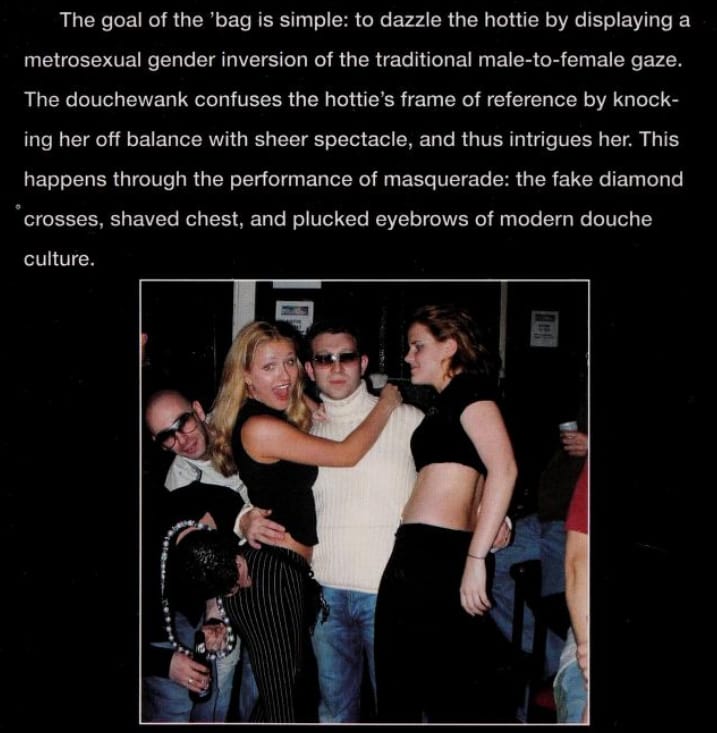
Or maybe the metrosexual is no fan of gay men at all but uses it as a scheme to attract women? Perhaps it was something fake, deceptive, and unfair to “regular” men. If women are attracted to “gender inverted” douchebags (as the comedy book Hot Chicks with Douchebags claims), then what is a self-respecting straight man to do? If you are unwilling to sacrifice your heterosexuality, how can you compete?
Even presidential candidate Howard Dean briefly claimed to be a metrosexual, seemingly a joke meant to highlight his allegiance to the LGBTQ community. After being mocked by the press, and perhaps afraid of seeming a little too LGBTQ himself, Dean backed away from his comment, saying “I don’t know what it means.”
Let’s add a final few items to our lists.
People
Tom Cruise, David Cameron, John Kerry, David Frost (as portrayed by Michael Sheen in Frost/Nixon), Arnold Schwarzenegger
Qualities
Doesn’t wear pleated pants, uses iPod docks, shops at Sunglass Hut, wears Lance Armstrong “Livestrong” bracelets, cooks with olive oil
This is getting hard to follow! And I am barely enumerating the array of behaviors that were considered not-straight at the time. Some of these items are obviously the delusions of clueless writers (Sunglass Hut is not chic) but that’s exactly the point: these were not observations of real behavior but straight men telling on themselves. The “metrosexual revolution” was not so much a fashion trend as a mass heterosexual confessional, a Festivus-style airing of the absurd number of things straight people consider suspiciously fruity.
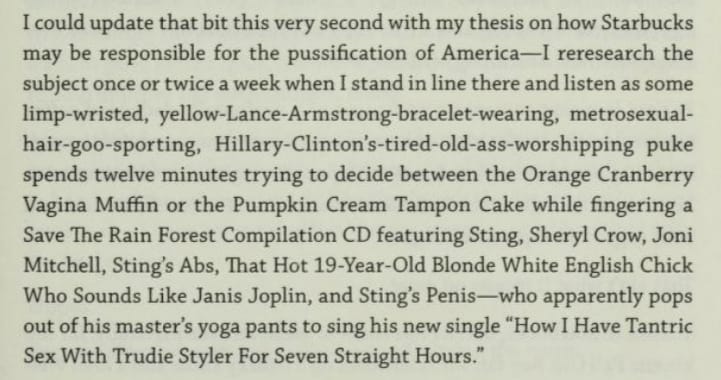
If you think I am being unfair or cherry-picking, here’s a single paragraph from Denis Leary’s 2008 book Why We Suck that, by itself, lists practically as many items as I have in this entire essay.
The Punchline
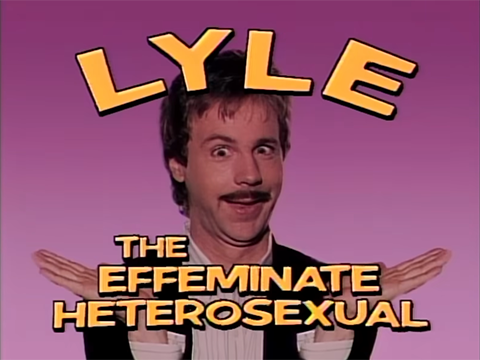
Heterosexuality defines itself as “normal” but is an impossibly narrow set of criteria. There are many ways to be gay and few ways to be straight. This is not my observation: the specificity and rigidity of straightness has been long and well discussed. Nor was metrosexuality the first time that effeminate fashion swept male culture: many precursors exist, like the Peacock Revolution of the 1960s and the dandies of the 1700s. SNL fans might also remember the 1992 Dana Carvey sketch “Lyle, the Effeminate Heterosexual.”
Some writers discuss metrosexuality in more-or-less this context: it was the latest in a long line of heterosexual spasms, a dominant culture colliding with deviant behavior. The metrosexual moment is, in this reading, passé. There is nothing unique about it except particularly tacky fashion. (Aughts fashion treated few people well.)
I do think we can learn one important lesson from metrosexuality, though, if not what it stood for then who stood against it. In 2005, advertising executive and self-titled “trendspotter” Marian Salzman wrote a book called The Future of Men. Salzman had worked at Euro RSCG, the agency that helped popularize the metrosexual trend, and was now looking toward a post-metro future. (Yes, the book has the same title as the earlier 2003 report.)
The Future of Men is a genre of writing well known to people today. Crises of masculinity occasionally bubble up in the swamp of discourse, most recently the “male loneliness epidemic.” In her book, Salzman argued that men were adrift, having lost identity and purpose because of the advance of once-subordinate groups (women especially). Social progress had eliminated the innate sense of dominance and fulfillment that men once enjoyed. Whatever will they do!
It would be easy to make fun of The Future of Men for being overly sympathetic to the unsympathetic clown that is the woe-is-me post-feminist man, but I think mostly the book is banal, describing self-evident shifts in American culture. It is a book written for other marketing executives and therefore pretty simple. (Executives do not read at a high grade level. The book literally bolds key passages for easy skimming.) The biggest swing Salzman takes is trying to coin a new word to describe the specifically modern sense of masculinity that these men desire. She proposes “M-ness,” a term that, safe to say, did not take off.
Salzman proposes another term, though: the “ubersexual” I mentioned earlier. The book itself is subtitled “The Rise of the Ubersexual and What He Means for Marketing Today.” Ubersexuals are “confident, masculine, stylish, and committed to uncompromising quality in all areas of life.” Their masculinity is complemented, not threatened, by powerful and independent women. Ubersexuals are elite men, role models to which lesser men can aspire.
They are also unambiguously straight. Salzman gives a few examples of the ubersexual man, and they are illuminating in ways she could not have anticipated. George Clooney was one such ubersexual despite his previous reputation as a primped metro. Another example, more ominously, is Donald Trump.
In 2007, an interviewer for The Guardian would ask Trump about this. This is the exchange:
I tell him futurologist Marian Salzman has described him as the ultimate 'ubersexual'. Would he say that was accurate?
'What does that mean?' he snaps, as if it were clearly an insult.
Well, I suppose it means you're sexy, I suggest.
'Oh,' he purrs, the slipperiest of smiles spreading across his lips, 'Well, tell her I like her also. I want a copy of that book. MEREDITH!'
Suddenly, his assistant is behind me. 'There's a woman called ...' Trump nods at me for the information. 'She wrote a book called ...' Another nod. 'Get it! She said nice things. She said I'm the ultimate ... whatever. Write her a letter, I'll thank her!'
Trump is a profoundly empty-headed man, easily flattered by what he is told is a compliment. (In an interview years later, Salzman said she never heard from him.) But he correctly sensed the truth: Salzman was not complimenting Donald Trump. She called him an ubersexual “in a twisted way,” not alike to George Clooney but a funhouse mirror reflection.
According to Salzman, Trump is a “throwback” of a man who “brooks no backtalk” from women. He certainly could not be called metrosexual, nor stylish, “solely on the basis of his atrocious hair. Honestly, would a true metrosexual leave his penthouse looking like that?” Salzman states that Trump is not a “Real Man” in the modern sense but a retrograde model, someone who might possess masculinity but not (sigh) M-ness.
The Guardian interviewer also asks Trump about his hair–it has always been famously stupid-looking. Trump insists on keeping it that way. The interviewer includes an anecdote featuring Tom Ford, himself called “Mr. Metrosexual” by one newspaper and a driving force of the trend.
At photographer Helmut Newton's memorial service in 2004, super-designer Tom Ford reportedly spent all evening telling Trump's then-fiancee Melania that she had to do something about Trump's hair.
In a world where masculinity is (so they say) under siege, where everything and everyone seems a little bit gay, where one cannot use olive oil or an iPod dock without arousing heterosexual suspicions, Donald Trump was never once considered even slightly metrosexual. Despite his flamboyance, despite his cakey makeup, despite the perverse care with which he grooms himself–he is still an “ubersexual,” someone who cannot be mistaken as anything but straight.
The metrosexual trend, as a fashion style and cultural moment, was ultimately short-lived. The fashion was divisive at the time and now considered unflattering (though sooner or later we’ll have our nostalgic revival). The jokes were little more than recycled gay-bashing.
But it drove straight people absolutely fucking bonkers. It drove them so bonkers that 20-something republicans who were barely conscious of the trend frothed at the mouth over it decades later. If straight men are still that pissed off about metrosexuals, I think it’s no coincidence we currently live under the rule of someone who was stridently not one.
Why, after all, do straight men relate to Trump, someone who dresses and acts in ways few people would call masculine? A 2020 Atlantic article called Trump “the most unmanly man” and asked this very question. In 2016, when Trump was only a primary candidate, a Slate article questioned how a woman–literally any woman–could find him attractive. Trump’s grotesqueness is for many people a puzzle.
I think it is a solution. Imagine for a moment you are a reactionary asshole. The world to you is an overstimulating Where’s Waldo scene. When you see something new, when you see two men kiss, when you see a woman dating a man in tight jeans, when you see either pleated or not-pleated pants, it is an affront to your worldview. Where others see a beautiful tapestry, you see only bewildering noise.
Donald Trump, because he looks like no other human on earth, is easy to identify. Donald Trump, despite looking like no other human on earth, is clearly and without a doubt a straight man–not because you know who he is but because he broadcasts it so vividly. The heterosexual grotesque is not a specific look but a kind of animalistic warning, like a snake’s rattle or a bear defensively shitting in the dirt.
As your gaze passes over the confusing and stressful static of the real world, Trump is, in a twisted way, a comforting visage on which to rest. He is the heterosexual Waldo*, wearing an even more bizarre outfit than a striped shirt and beanie. It doesn’t matter that you’d never dress like him, it doesn’t matter that you’d never act like him. What matters, goddamnit, is that nobody would call him gay. They wouldn’t even call him metrosexual.
*Waldo, of course, is bi.
Background reading
While this essay takes some jokes of the era as a springboard, much has been written about this trend from many perspectives, from transgender critics of the aughts to Latin American journalists reporting on the trend from Puerto Rico to writers who link metrosexuality to today's "looksmaxxing." I could not remotely do justice to them all. I have included links to Mark Simpson's original essays here and encourage anybody curious to explore the topic.
"Here Come the Mirror Men." The Independent. 1994.
"Meet the Metrosexual." Salon.com. 2002.