Honk If You're Horny


The Setup
DIANE: For some strange reason, I find it hard to respect a man with a bumper sticker, "Honk if you're horny."
SAM: (laughing) That's pretty good.
CLIFF: (laughing) Yeah. Honk honk honk honk!
–Cheers, "Love Thy Neighbor," 11/21/1985
It is a joke so mouth-gapingly stupid that the stupidity has become the point. “Honk if you’re horny” can be seen as a masterclass in the lowbrow, a mashup of two of the crudest behaviors known to modern man: being horny and, consequently, honking your damn horn. The phrase is so antipodal to cleverness that it has become shorthand for pranksters who want to appear conspicuously dumb. In 2012, hackers changed road signs in Louisville to read “Honk if you’re horny" (Baker City Herald, 6/22/2012). In 2011, two high school seniors outside Austin were charged with felony mischief for, among other things, changing their school marquee to read “Honk if you’re horny” on both sides (Austin American-Statesman, 6/9/2011).
In recent years, the phrase has shown up in Tim Robinson’s I Think You Should Leave. Conner O'Malley plays a man who spots a "Honk if you're horny" bumper sticker and reads it literally. He pursues Tim Robinson in the demented way that only Conner can, begging for a salve to a horniness so severe that his stomach hurts. (He is very good at this kind of character.) This is an all-gas-no-brakes kind of sketch: the only way out is through, to commit 1,000% to the bit about this famously stupid bumper sticker.
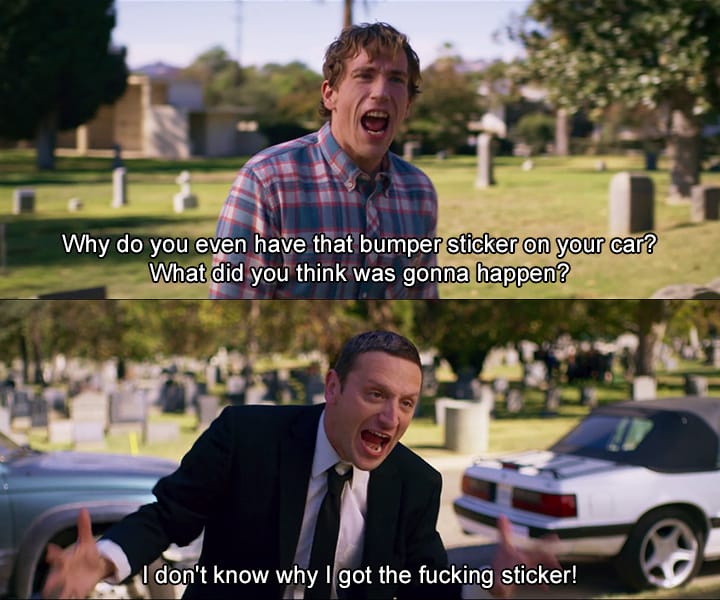
“Honk if you’re horny” is so stupid that it has become a recurring piece of internet content that it’s actually a little smart. You can find social media threads and blog posts revealing that the joke is a pun on automobile horns. Some readers might have already gotten the wordplay, but I’ll admit I didn’t until it was pointed out. This hiding-in-plain-sight trivia does tickle the brain if you didn’t know it but starts to grate when you encounter it for the fifth or sixth time. (It was once so common for people to point out the arrow in the FedEx logo that it became an exasperating cliche.)
The wordplay of “Honk if you’re horny” has, however, become something of a false history. The pun is presented as the “origin” of the phrase or what it “really” means. It is, in this telling, just a one-liner cooked up by a comedian. Funny, but not something that requires an elaborate explainer.
I believe there is more to say about honking if one is horny. Considering the subject matter, maybe a baffling amount. This story will require a short trip through two big subjects. The first makes sense: the invention and rise of bumper stickers in midcentury America. The second subject is harder to guess, but give yourself the point if you wrote down “Christian evangelism.”
Though automobiles had been around for decades, and people have always decorated the backsides of their vehicles, regular people using their bumpers to promote their own beliefs was a midcentury invention. Bumper stickers–printed stickers with self-adhesive backs–date to the 1930s or 40s. The New York Times credits a Kansas City man named Forest Gill with inventing the product in the mid-40s, though my own research suggests they predate Gill and were sold in the 30s. My personal feud with The New York Times aside, the general timeline is correct: World War 2 was a pivot point for car ownership in the United States, and ownership rates shot up after the war.
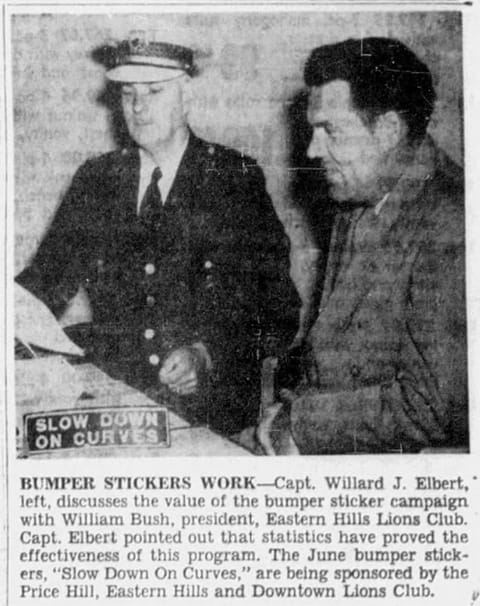
If Americans love anything, they love to advertise, and bumper stickers quickly swept the nation. Bumper stickers were used to advertise everything from local events to presidential candidates to, at least in one city, traffic regulations. In the 1950s, the government of Cincinnati tried to improve road safety with civic-minded bumper stickers reminding fellow drivers of the rules of the road. I question the effectiveness of the program–how impactful could a bumper sticker that reads “Slow Down On Curves” (the slogan of the month for June 1952) actually be? But the program continued for years, perhaps to avoid addressing more serious problems. Cincinnati saw record-setting drunk driving cases at the time (The Cincinnati Post reported 14 cases heard in a single day–January 8, 1952), and drunk driving was still legal in other parts of Ohio. (If Americans love a second thing, it is drunk driving.)
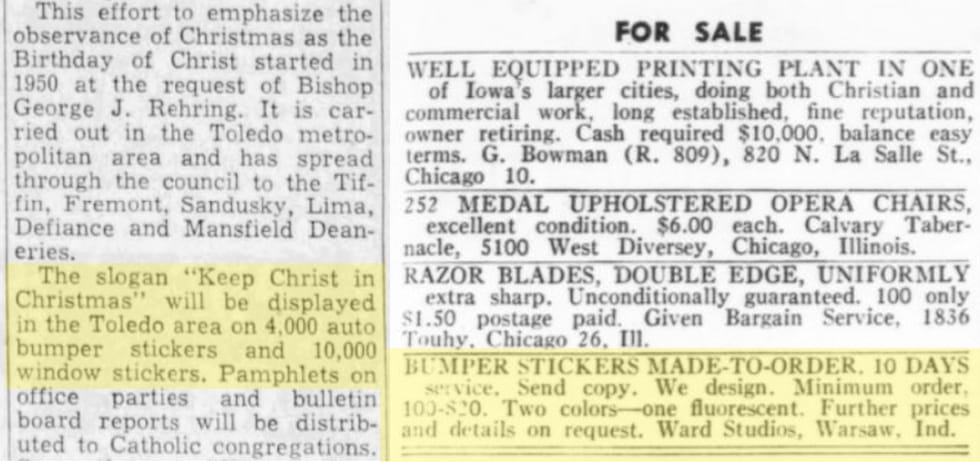
One important group also glommed onto this advertising strategy: Christians. In the 1950s, churches across the country coordinated massive bumper sticker campaigns. This was cross-denominational, from Catholics in Houston to Methodists in Toledo. “Keep Christ in Christmas” was a particularly favorite campaign, with Christian groups distributing tens of thousands of bumper stickers across various cities, but plenty of other slogans and events were advertised too. This was so common that bumper sticker manufacturers advertised in Christian magazines.
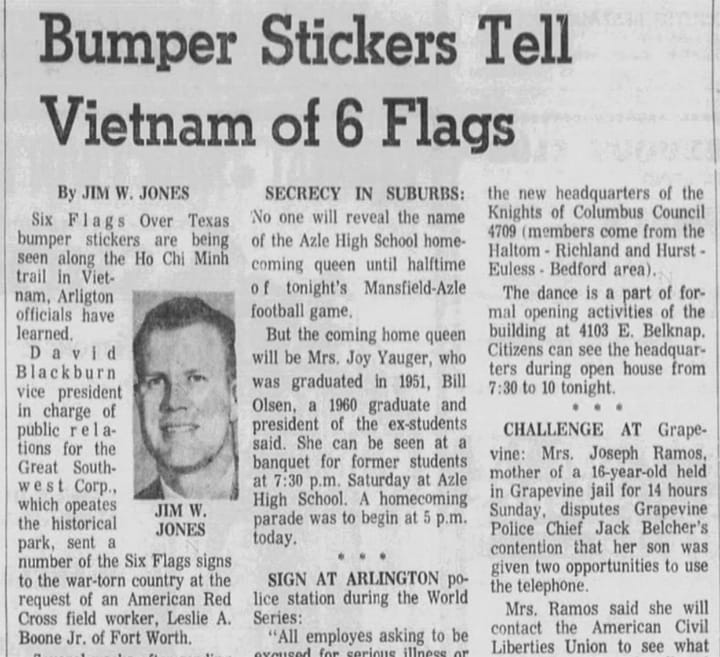
By the 1960s, bumper stickers were ubiquitous. During election years, newspapers reported informal “bumper sticker polls” as a quick-and-dirty gauge of the popularity of presidential candidates. Stickers were impossible to avoid during off-election years too. Bumper stickers were sold as fundraising products for everything from local bands to police departments. Car dealerships gave them away as promotions. In 1967, in a move I might generously describe as “tasteless,” Six Flags Over Texas (yes, the theme park) sent Six Flags-branded bumper stickers to soldiers in Vietnam. According to Six Flags' then-PR head, the stickers were meant to give the boys a "break from the routine and an awful lot of fun." I'm sure they did.
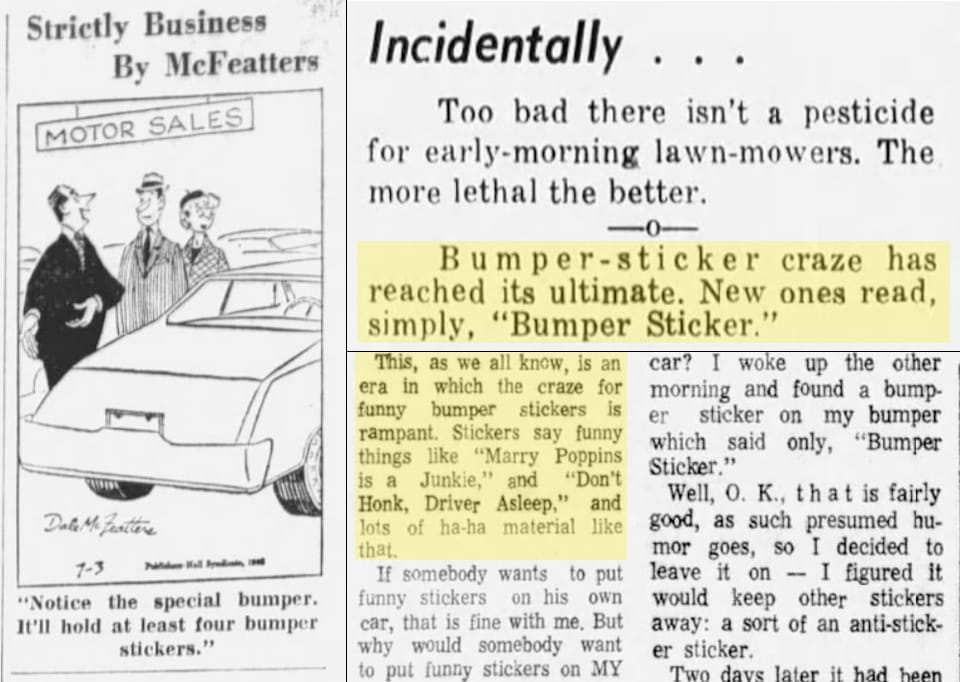
Comedy bumper stickers, of course, arrived too. As bumper stickers emerged as a kind of public conversation, jokes naturally followed. One reporter described the “ha-ha” stickers as a “craze" and claimed that pranksters kept planting unwanted stickers on his vehicle. The volume of bumper stickers was overwhelming enough to compel meta humor: another newspaper reported on an amusing sticker that read only “Bumper Sticker.”
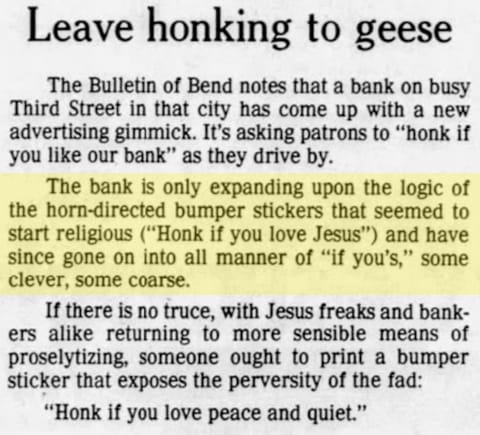
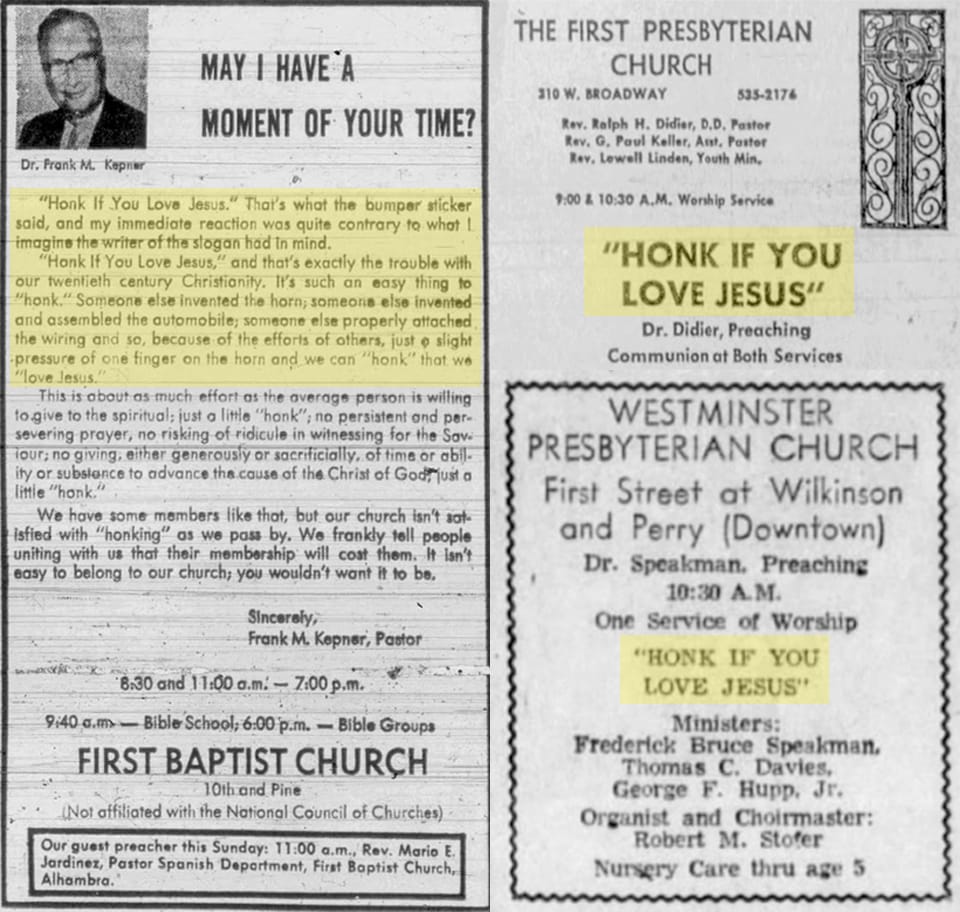
As we approach the 1970s, bumper stickers stood on the precipice of horniness, but to reach “honk if you’re horny” we must first understand the “honk if…” framework. And “honk if” bumper stickers were first Christian propaganda. Bumper stickers that directed drivers to “Honk if you love Jesus” propagated in the 1960s. “Honk if” stickers seem silly today, especially because of the subsequent jokes, but these were not tongue in cheek. Far from it–these stickers were utterly sincere. My own research dates “Honk if you love Jesus” before any joke version, and one contemporary reporter speculated that the stickers originated among the religious.
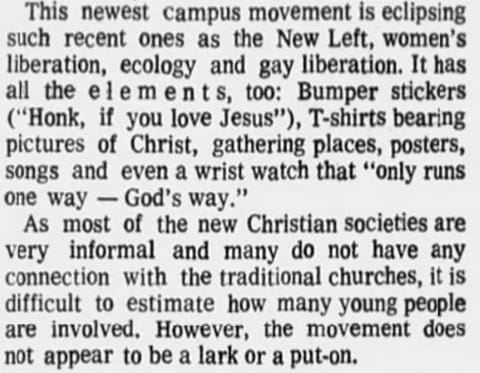
I have been careful to avoid defining these Christian groups as right or left, though many were conservative, because one of our major players is a left-leaning group on the west coast. The “Jesus movement” was a hippie-inspired evangelical movement originating in California before spreading east. The Jesus movement was a particularly woo-woo school of Protestantism, a countercultural drum-circle sort of Christianity that attracted many young people who gathered in communes called “Christian Houses.” The term “Jesus freak” was originally coined to describe members of the Jesus movement, “freak” a term originally associated with drugs and hippie culture.
Many people considered Jesus freaks a public nuisance. They held frequent demonstrations and public meetings, and they fundraised by selling bumper stickers. The bumper stickers became a defining feature of the movement, and one of their preferred slogans was “Honk if you love Jesus.” (It is possible that the Jesus freaks invented this specific phrase, but I can’t say for sure.) These stickers were not, as one reporter said, "a lark or a put-on." The point was to be loud and attract attention.
And so we come to horniness. The earliest example I can find is a September 1971 mention of a plate that says “Honk once if you’re horny," and multiple other newspapers report being tickled by this funny bumper sticker around the same time. Though the phrase's exact origins are unknown, I think it is safe to date the phenomenon to roughly 1971, and it blew up virtually overnight. By 1972, “Honk if you’re horny” bumper stickers and license plate frames were commercial products you could easily purchase.
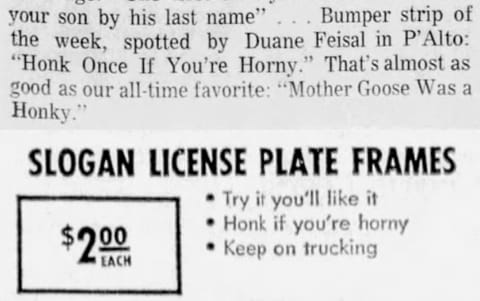
Though it is possible to read “Honk if you’re horny” as a self-contained joke, something that is both a pun and just something so stupid that it’s funny, it would have been clearly understood as a response to evangelical bumper stickers. (To emphasize that the honk-horny pun was secondary, you can find similar license plates without the pun at all. “Honk if you like sex” was a common variant and has no such wordplay. ) This is not merely my supposition: contemporary writers presented them as a pair.
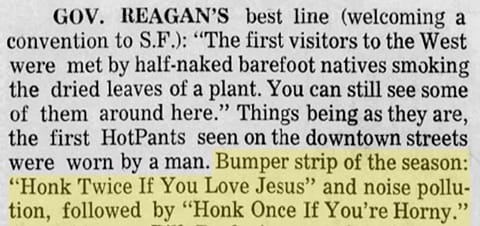
In other words, the reference to Jesus freaks would have been overt–it would have been the joke. In a direct, literal sense, “Honk if you’re horny” was a protest against Christian evangelism. In terms of sentences I never expected to write, this ranks pretty high.
The Punchline
This bumper sticker battle took place within a wider environment of so-called “pop religion.” A schism of sorts emerged between big-money, marketing-brained Christian leaders and more traditional, humbler adherents. The consumer economy reigned after World War 2, and with consumer spending came a rise in advertising. The church became dangerously entangled with the culture of Madison Avenue, according to worried members of the flock, and Christ became a product to be bought and sold.
Religious historians might question how “new” this really was, the church having always balanced the practice of faith against the pursuit of wealth, but the issue took on a modern sheen with people comparing modern church marketing to soft drink commercials. Ostentatious bumper stickers were a handy metaphor for the shallowness of pop religion, and preachers delivered sermons on this very topic.
One religious leader satirized the scourge of pop religion in a comedic novel about wayward Christians. Joseph T. Bayly was a publishing executive with a theological background and a signatory of the 1973 Chicago Declaration of Evangelical Social Concern, a liberal evangelical document that denounced racism, sexism, militarism, and other contemporary evils. Years before signing the Chicago Declaration, Bayly wrote The Gospel Blimp, which was turned into a film in 1967.
As far as I can tell, The Gospel Blimp did not release theatrically but was screened for churches and youth groups throughout the country. Considering it is a sincere work of Christian evangelism, you might expect it to be preachy or corny, but I found it refreshingly funny. It is a mockumentary-style comedy, decades before such a style was de rigueur, about suburban Christians trying to convert their non-religious neighbors.
The film opens on a suburban backyard, with a group of Christian friends gossiping about their neighbors. Rather than reach out personally, the Christians concoct an idea to fly a blimp displaying Bible verses over town. The idea itself is a joke, self-evidently foolish, and the film emphasizes the metaphor by placing the neighbors under a massive umbrella, physically unable to witness any blimp sloganeering.
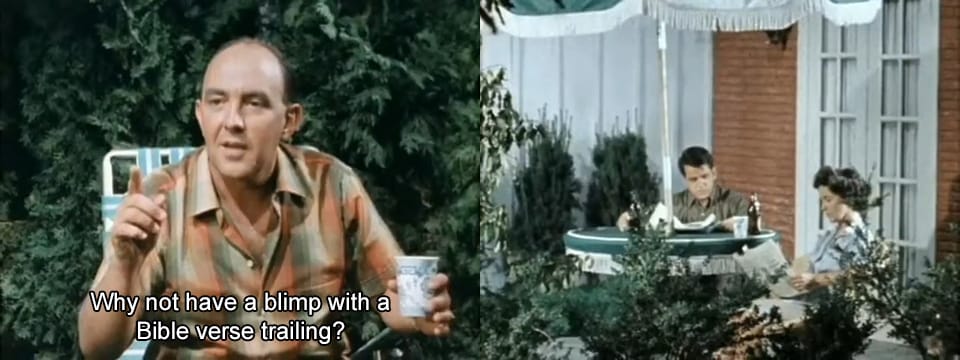
The blimp is a nonstop disaster. The vessel gets stuck between buildings downtown. The blimp-Christians drop trinkets and blast music to the annoyance of local townsfolk. At one point the blimp’s audio system interferes with TV broadcasts, driving townsfolk into such a rage that they attempt to shoot the blimp out of the sky.
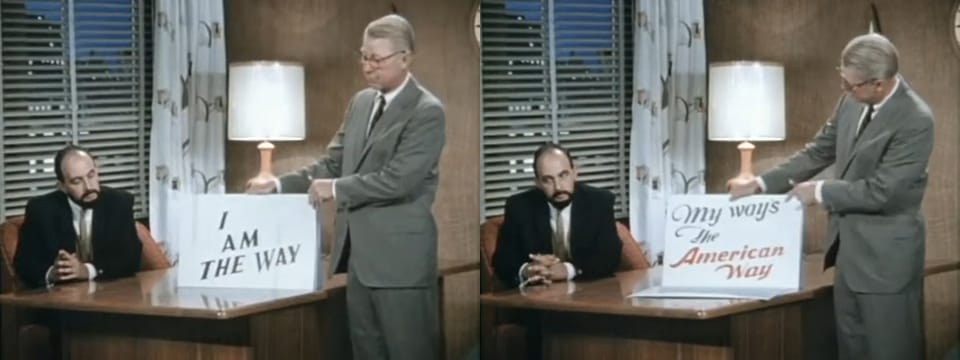
Throughout all this, the blimp-believers are undeterred. They incorporate as a business (“International Gospel Blimps Incorporated”), and eventually a slick “PR man” takes over. In one scene, the PR man suggests they modify traditional Bible verses into more marketable slogans, and the film makes no secret of its belief that this blending of Christianity and marketing is a distinctly American sickness.
The Gospel Blimp is a Christian film and ends with a Christian message–the non-religious neighbors are ultimately converted after in-person social visits and a heart-to-heart beach trip. You convert your fellow man not with slogans but with personal outreach. I believe, however, that the movie reflects a general anxiety of that era and our eras since. “Pop religion” was just one symptom of the warping of public discourse within the cacophony of consumer culture.
It is comforting to imagine a world we can control by influence rather than conversation, where you can bypass difficult discussions by purchasing the correct bumper sticker. “Honk if you love Jesus” seeks victory by volume, as if public life is an arena where the audiences that stomp their feet loudest win. And it is comforting to imagine the counterpoint to that worldview, that a pithy joke can deflate one’s opposition. In either case, you don’t have to work up the nerve to talk to your neighbor.
Of course, human beings do not communicate with other human beings this way–not meaningfully, at least. You cannot achieve conversation-by-bumper-sticker any more than you can have public debates via social media bios festooned with emoji. Then, as now, people fretted about the fraying of social threads. They worried that social isolation created vulnerabilities for powerful forces to exploit. The Gospel Blimp worries that secularism and profiteering are on the rise and that would-be Christians might seek dysfunctional coping mechanisms. (Alcoholism is invoked multiple times.) But all groups fear the effects of isolation, of alienated individuals suffering physical and emotional hardship.
In recent years, “context collapse” has been an influential term to describe online interactions. Context collapse occurs when a variety of distinct audiences overlap and participants in a conversation no longer share common knowledge or assumptions. In other words, the nuance and specificity of conversation is lost, and the common ground participants share shrinks as more participants are added. “Context collapse” was coined specifically to describe online discussions but draws from earlier research, and I would argue you can see the precursor to context collapse in the bumper sticker craze of the 60s and 70s. Bumper stickers were expressions of strongly held personal beliefs, political affiliations, personal interests, and jokes–and then responses to all of these things too. And each bumper sticker was beamed out toward whoever happened to be behind the driver–friends and neighbors, coworkers and cops, townies and out-of-towners, and total strangers.
The history of “Honk if you’re horny” is thus the history of a phrase collapsed into incomprehensible goo. What began as a pointed joke about an evangelical movement became, absent that context, just a funny pun. And that funny pun, shown to millions more, lost its punniness to become a notoriously stupid slogan, a reflection of the driver’s apparent crudeness.
And now that notoriously stupid slogan is so divorced from any context that there is widespread confusion over its meaning. In January 2026, Upworthy published an article titled “The ‘honk if you…’ bumper sticker sparks spirited debate about what honking really means.” British publication The Mirror posted a similar article in 2024. Rather than the bumpers being jokes in themselves, some now believe that “honk if” bumper stickers are pranks meant to confuse or enrage other drivers. They preemptively disarm righteous honkers by changing the meaning to something unintended. If you honk at me for driving badly, I will interpret that as you being horny–or supporting a teachers strike, as in this joke from The Simpsons.
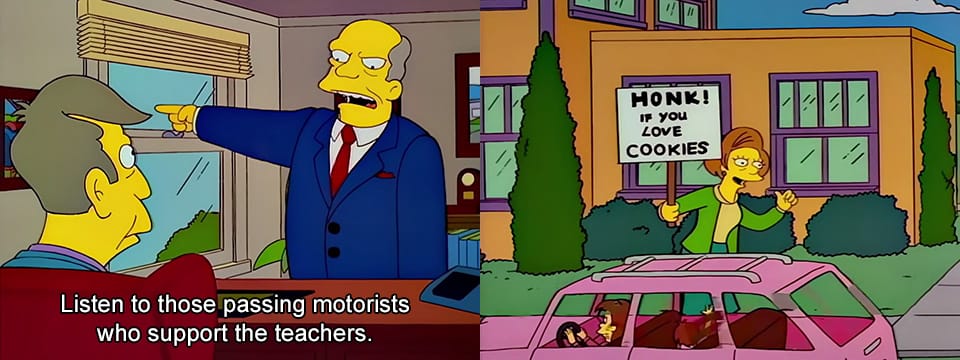
“Honk if” bumper stickers are now so tortuously meta that I am sure it’s true that some people intend them as ironic pranks. But this is an ex post facto interpretation of an old joke, a way to make sense of a phrase mangled in the cultural blender. I am sure others display the sticker as ironic kitsch, and there are probably still a few individuals out there who, like Sam and Cliff, think it’s just plain funny. I doubt there is a single car left on the road that wears the sticker in its original fashion, in response to a 60-year-old religious movement, but maybe some automobile from that era survives with its sticker intact.
If seen in the wild, such a bumper sticker could mean anything or nothing. It would be foolish to try and resolve this with more bumper stickers, to simulate a conversation with fresh applications of self-adhering slogans. There is, The Gospel Blimp would tell us, no way to know just by looking. The only way to know for sure would be to get out of your cars and talk to each other, not in faceless public arenas but face to face, person to person. That, at least, might begin to fix Conner's horny stomach ache.
Background reading
Diana, M. Casey. Jesus People Movement. 2022.
Holdier, AG. "Context Collapse." 2026.
Kennedy, Pagan. "Who Made That Bumper Sticker?" 2019.